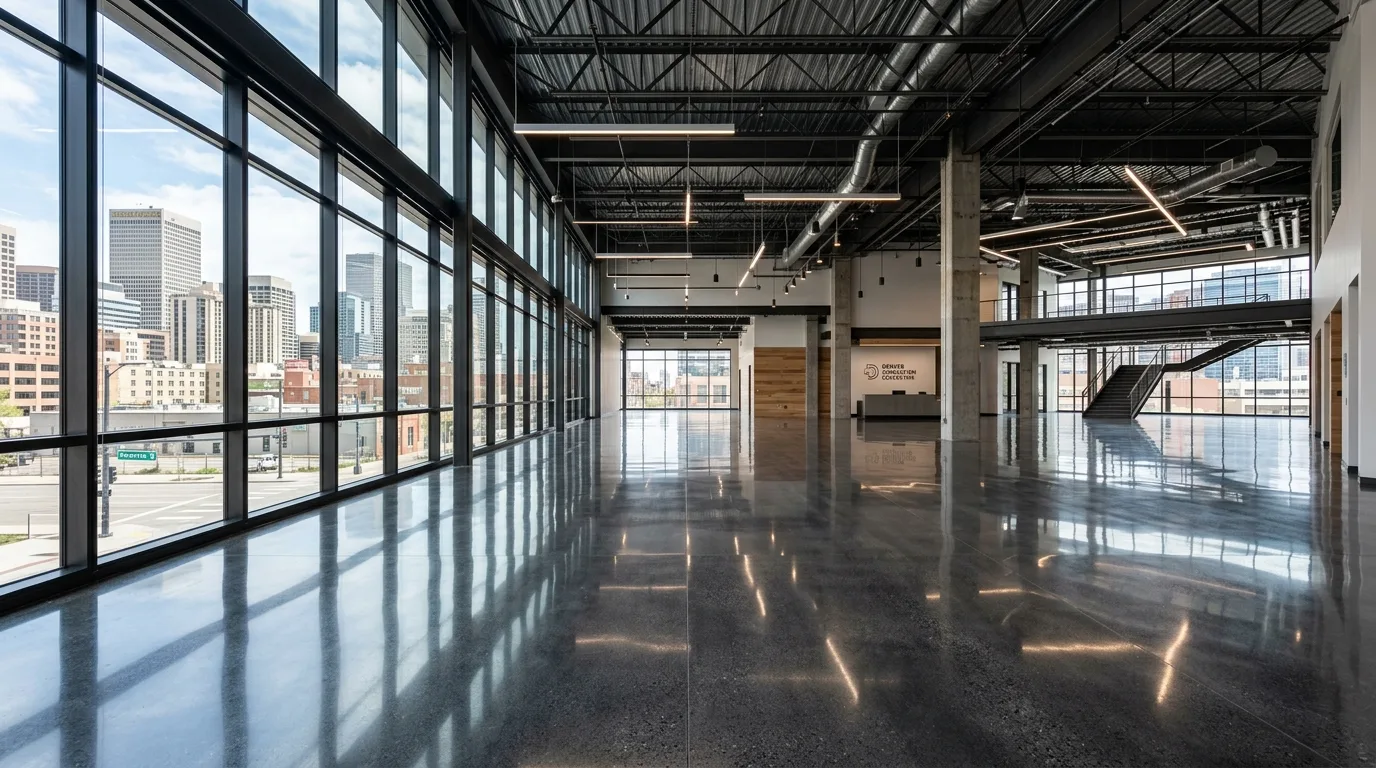
Concrete Polishing Denver: What Diamond Grinding Delivers for Your Colorado Floor
From satin to mirror finish, diamond-polished concrete is the most durable floor surface you can install on an existing slab — and Denver's dry climate makes it perform exceptionally well.
Polished concrete is the only floor treatment that gets harder and more reflective over time. Diamond grinding mechanically compacts the concrete surface, densifier chemically hardens it, and successive grits refine the finish from rough aggregate exposure to a gloss that rivals polished stone. Unlike coatings, polished concrete can't peel, chip, or delaminate — because there's nothing on top of the slab. This guide covers every gloss level, every cost, and how Denver's climate makes concrete polishing in Denver an exceptionally practical choice.
Satin Finish$3 – $5 / sqft
Semi-Gloss$4 – $6 / sqft
Mirror Finish$6 – $8 / sqft
Gloss Levels Explained: 100 to 3000 Grit
Polished concrete gloss is determined by the final grit used — the higher the grit, the finer the surface scratch pattern, and the more light it reflects. Each level serves different spaces and aesthetics.
1
100–200 Grit — Flat / Matte
Prep and grinding phase
Removes surface laitance, old coatings, and contamination. Not a finished surface — this is where all polishing starts. Some industrial clients stop here for a clean, non-reflective floor.
2
400 Grit — Satin
Low reflectivity, hides imperfections
The most common finish for warehouses, retail back-of-house, and industrial spaces. Slight sheen, maximum durability, minimal maintenance. Densifier applied at this stage before continuing to higher grits if desired.
3
800 Grit — Semi-Gloss
Moderate reflectivity, popular for retail
Most popular finish for Denver retail stores, restaurant floors, and office lobbies. Visible sheen that brightens the space without being mirror-reflective. Shows aggregate and color variation in the slab — which many clients prefer.
4
1500–3000 Grit — High Gloss / Mirror
Maximum reflectivity, showroom quality
Mirror-finish polished concrete reflects ceiling fixtures and merchandise displays. Used in high-end retail, automotive showrooms, hotel lobbies, and luxury residential. Guard coat applied at this stage for slip resistance and surface protection.
Aggregate Exposure Options for Denver Slabs
Alongside gloss level, aggregate exposure is the other major design choice. It determines how much of the slab's internal stone is visible in the finished floor.
⬛
Cream Polish (No Exposure)
Grinding stays at the surface — only the cement paste is polished. Uniform color, no visible stone. Best for slabs with attractive paste color and minimal cracking or pitting.
🔲
Salt-and-Pepper
Light grinding exposes small aggregate particles throughout the surface. The most popular Denver look — natural, understated, works in any style space from industrial to contemporary.
🟤
Medium Aggregate
Deeper grinding reveals larger stone throughout. Dramatic and distinctive — each slab is unique based on its aggregate blend. Popular in high-end residential and boutique commercial spaces.
🪨
Full Aggregate Exposure
Maximum grinding reveals large stones completely. Terrazzo-like appearance. Best for slabs with attractive aggregate — requires assessment of what's in the slab before specifying this level.
High-gloss 3000-grit polish with guard coat — the finish used in Denver retail and showroom environments.
Polished Concrete vs Epoxy for Denver Spaces
Both are excellent floor options — but they serve different needs. The right choice depends on the space, the slab, and how the floor will be used.
Factor
Polished Concrete
Epoxy
Longevity
20+ years, no recoat needed
10–20 years before refinish
Maintenance
Periodic burnish only
No wax needed; re-topcoat if worn
Design options
Gloss + aggregate exposure
Color, flake, metallic, quartz
Best for
Retail, office, showrooms, restaurants
Garages, warehouses, basements
Slab requirement
Structurally sound, minimal cracks
Tolerates more surface damage
Denver advantage: Low humidity at altitude means minimal moisture vapor emission from Denver slabs — a common cause of coating failure in humid climates. Denver concrete polishes and coats exceptionally well, and polished concrete's long-term durability is enhanced by the dry environment that keeps the guard coat performing longer between maintenance burnishes.
Cost of Concrete Polishing in Denver
Polished concrete pricing depends on current slab condition, grit level, and whether staining or custom color is added. All ProEpoxy polishes include densifier and guard coat as standard — not add-ons.
Finish Level
Grit
Cost / Sq Ft
SatinDensifier + guard coat
400
$3 – $5
Semi-GlossDensifier + guard coat
800
$4 – $6
High GlossDensifier + guard coat + burnish
1500
$5 – $7
MirrorDensifier + guard coat + double burnish
3000
$6 – $8
Dye / Stain Add-OnColor or reactive acid stain
—
$0.50 – $2
Frequently Asked Questions
How long does polished concrete last in Denver?
20+ years with basic maintenance. Unlike epoxy, polished concrete never needs a full recoat — periodic re-burnishing restores gloss and hardness. Denver's dry climate is ideal for polished concrete longevity.
Does Denver's dry climate affect polished concrete?
Low humidity actually helps — less moisture vapor risk than humid climates. Denver slabs typically have lower moisture vapor emissions than coastal or Gulf Coast cities, making them ideal candidates for polishing. The dry air also extends burnish life between maintenance cycles.
Is polished concrete slippery?
No — a penetrating guard coat applied after densification provides slip resistance comparable to textured tile even when wet. Higher gloss levels (3000 grit) require the guard coat; lower gloss levels (400–800 grit) have inherent surface texture.