Commercial, Industrial & Garage Epoxy Floors
From RiNo warehouses to Highlands Ranch garages, we install epoxy and polished-concrete floors engineered for Denver freeze-thaw cycles, hot-tire pickup, and nonstop traffic. One dedicated crew owns your prep, coating, and finish - start to finish, on schedule.
Epoxy flooring in Denver has to handle a mile of altitude, strong UV, January days that swing across freezing and slabs poured on swelling clay. A good epoxy floor coating here starts with diamond grinding and a moisture test, uses a 100% solids epoxy base and finishes with a UV-stable polyaspartic topcoat. Residential systems on our published price guide run $3-$7 per sq ft installed, commercial systems $5-$12, and most two-car garages are finished in one day.
Epoxy flooring in Denver fails for local reasons, and most of them come down to five things our crews check on every walkthrough. The numbers below come from the National Weather Service office in Boulder, the Colorado Geological Survey and the Rocky Mountain Insurance Information Association.
The World Health Organization estimates UV levels rise about 10 percent for every 1,000 meters of elevation. At roughly 1,600 meters, a Denver garage with the door up on a summer afternoon sees noticeably more UV than the same garage at sea level. Standard aromatic epoxy ambers under that light, often within a season or two near the door line. That is why every garage epoxy Denver job we install gets an aliphatic polyaspartic topcoat, and why we read the sun angle on west-facing doors before picking colors. Our altitude and UV guide covers the chemistry.
NWS normals for January put Denver's average high at 44-45°F and the average low at 18-19°F. That means many winter days thaw at noon and refreeze at night. Snowmelt runs off tires, pools at the garage apron and works into any open crack. A coating with pinholes or a weak edge at the door threshold lets that water under the film, and the next freeze lifts it. We feather the coating onto the apron edge and fill joints so meltwater has nowhere to sit.
Denver has hit 105°F, its all-time high, on five separate dates, most recently June 28, 2018. The city logged 75 days of 90°F or hotter in 2020, the most in a season since records began in 1872. Tires coming off I-25 in July are hot enough to soften and lift a thin, poorly bonded coat. Full-thickness systems on a ground profile hold.
The City of Denver uses liquid magnesium chloride downtown and can pre-treat main streets before a storm. That brine rides into garages and loading bays on wheel wells. It stains bare concrete, scales weak surfaces and leaves a white film on soft coatings. A chemical-resistant topcoat and a quick rinse every few weeks in winter keep it in check.
The Colorado Geological Survey calls expansive soil Colorado's most significant geologic hazard and lists cracked garage and basement floor slabs as a common sign. Clay-rich soils can swell 10 percent or more by volume when they get wet. No coating stops a slab from heaving, so we map existing cracks, tell you which ones are still moving and fill those with a flexible joint material instead of rigid epoxy. Hail matters too: RMIIA puts the May 8, 2017 metro storm at $2.3 billion in insured losses, the costliest in state history. Many of our garage clients want the car inside from spring through summer, which means the floor sees daily tire traffic.
Every floor is poured, ground, and coated by ProEpoxy's own Denver crews - never subbed out. Here's the work we do most across the metro, and the systems we reach for on each.
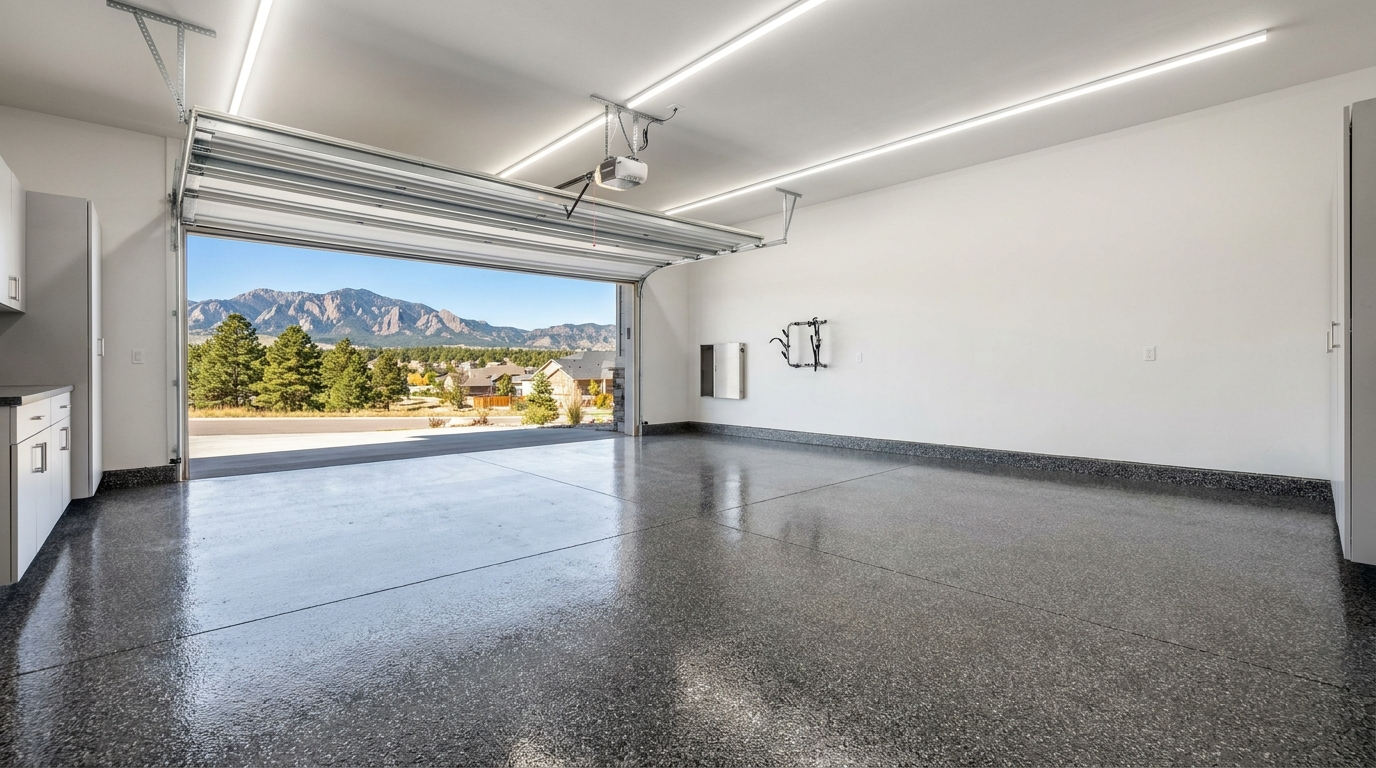
Turn a hot, dusty Denver garage into a clean, showroom-grade space. Our flake and metallic systems shrug off hot-tire pickup, oil drips, and summer heat soak - with 50+ color blends to choose from. Most single and double garages are done in a day, ready to drive on that weekend.
Learn more
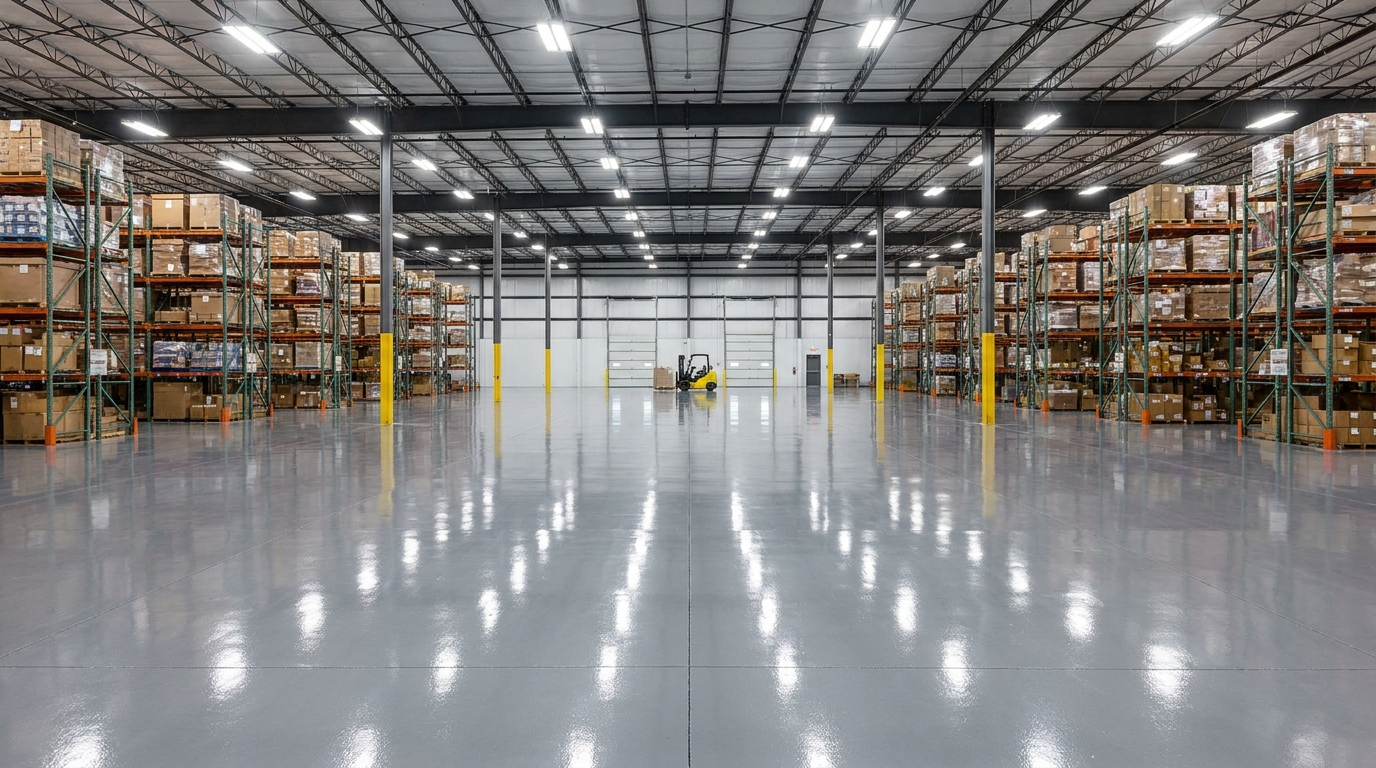
Warehouses off I-25 and I-70, distribution centers, machine shops, and manufacturing floors take a beating - forklift traffic, dropped tools, coolant and solvent spills. We spec high-build epoxy and urethane systems that hold up for 20+ years and keep your operation running with phased, off-hours installs.
Learn more
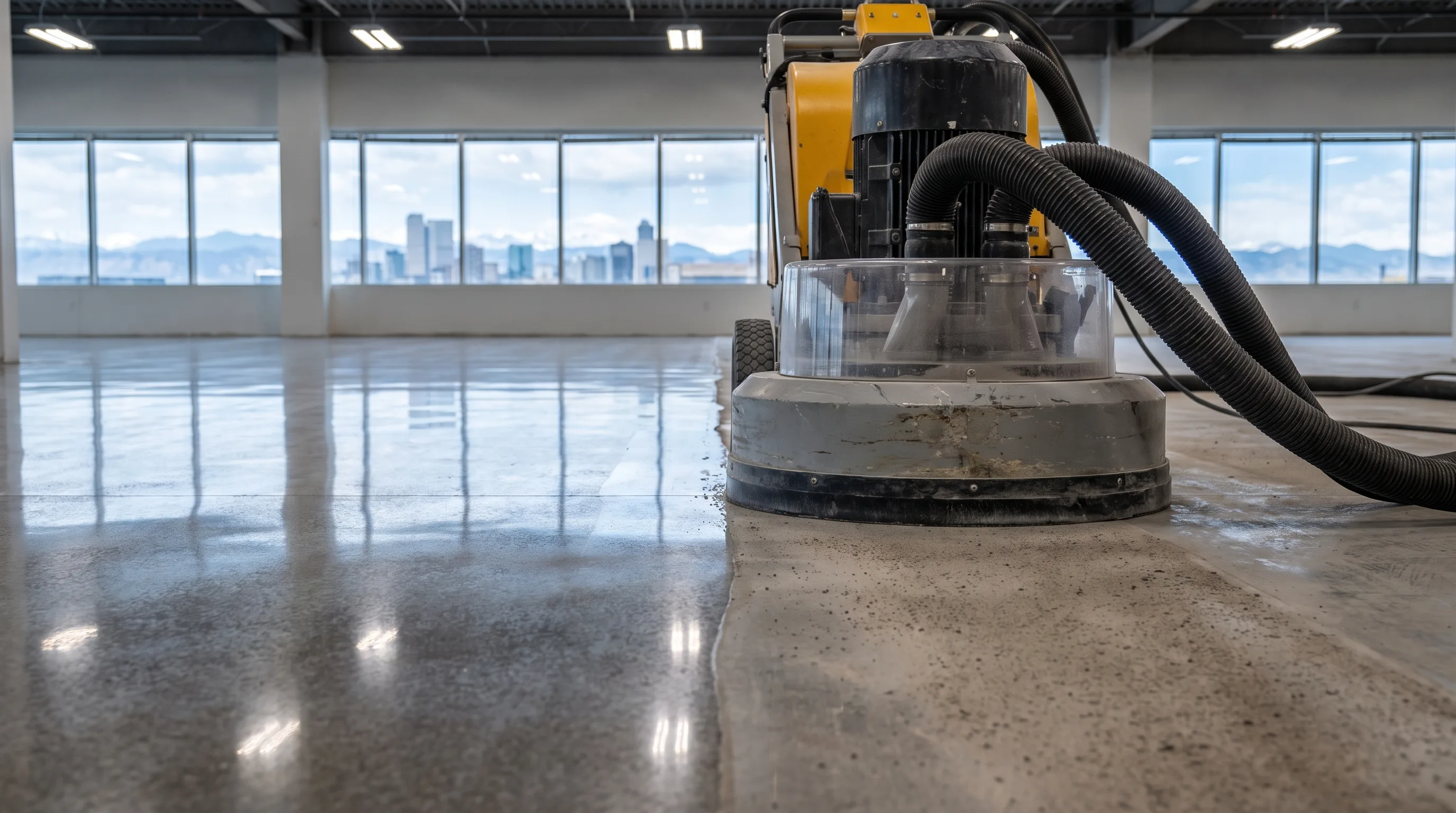
Polished concrete is the workhorse floor for Denver retail, breweries, and open-plan offices - no coating to peel, just your slab densified and ground to a satin or mirror sheen. It laughs off scuffs and rolling loads, needs nothing but a dust mop, and keeps interiors cooler by bouncing light around.
Learn moreAn epoxy floor coating in Denver is rarely epoxy alone. Most of our floors are hybrids: an epoxy base for build and bond, then a different chemistry on top for UV, chemical or thermal duty. Here is how the five systems we install line up against Front Range conditions.
| System | Strength in Denver conditions | Weak spot | Where we use it locally |
|---|---|---|---|
| 100% solids epoxy | Thick build, strong bond to a ground slab, good impact resistance under forklifts | Ambers in direct UV unless topcoated | Base coat on garages, warehouses off I-70 and I-76, machine shops |
| Polyaspartic | UV stable at altitude, cures fast enough for a one-day garage, can go down in cooler shoulder-season weather | Short working time on a 90°F afternoon | Topcoat on nearly every garage and showroom we do |
| Polyurea | Flexible, bridges hairline cracks from minor slab movement, wide application temperature range | Needs experienced hands; less forgiving on wet slabs | Parking decks, exterior-exposed slabs, loading docks |
| Urethane cement | Handles boiling-water washdown and thermal shock | Matte look, higher cost | Brewhouses, commercial kitchens, food processing |
| Polished concrete | No film to peel or yellow, ideal where hail-season traffic tracks grit | Shows slab cracks and stains that are already there | Retail, offices and brick warehouse lofts in RiNo |
For a homeowner choosing between a straight epoxy flake floor and a full polyaspartic system, our epoxy vs polyaspartic comparison walks through the trade-offs. Facility managers weighing film coatings against a ground floor can read polishing vs epoxy cost in Denver.
Epoxy flooring Denver pricing on our site runs higher than most national averages, mainly because of the UV topcoat and the prep that local slabs need. These are the installed ranges from our own Denver cost guide and service pages. Your written quote comes after a free on-site look at the slab.
| Job type | Installed price | Notes |
|---|---|---|
| One-car garage, flake | $1,200-$1,800 | About 200-250 sq ft |
| Two-car garage, flake | $1,800-$2,800 | About 400-500 sq ft, polyaspartic top included |
| Three-car garage, flake | $2,800-$4,500 | About 600-750 sq ft |
| Metallic epoxy | $8-$15 per sq ft | Garages, lobbies, showrooms |
| Basement floor | $5-$10 per sq ft | Moisture work drives the range |
| Warehouse, standard to chemical-resistant | $4-$12 per sq ft | Forklift-rated high-build sits at $6-$9 |
| Commercial kitchen (NSF epoxy or urethane cement) | $8-$14 per sq ft | Cove base and drains add labor |
| Polished concrete | $3-$8 per sq ft | Depends on grind level and crack repair |
| Grind and seal | $1.50-$3 per sq ft | Entry-level dust-proofing |
We don't sell buckets and wish you luck. ProEpoxy is a full-service installer - our own trained crews handle moisture testing, diamond prep, coating, and the final walkthrough on every single job.
A floor is only as good as the prep under it. Here's the exact 5-step sequence our crews run on every Denver job, whether it's a two-car garage or a 60,000 sq ft plant.
We calcium-chloride and RH test for moisture, then open the slab with diamond grinders or shot blast for a mechanical bond that lasts.
Spalls, cracks, and control joints get chased out and filled with rapid-set polymer mortar so the finished floor reads flat and seamless.
A deep-penetrating primer locks into the profiled slab - and doubles as a moisture-mitigation layer when the slab needs it.
Build coats go down to spec thickness - this is where broadcast flake, metallic pours, or solid-color builds take shape.
A UV-stable topcoat seals it all in, then we walk the floor with you against a 12-point checklist before we hand over the keys.
Our epoxy flooring company in Denver schedules around slab temperature, not the calendar. Resin cures by chemical reaction, and a cold slab slows that reaction even when the air feels mild. Here is how timing shifts through a Front Range year.
More detail is in our Denver epoxy maintenance guide and the post on cold-weather polyaspartic installs.
Commercial epoxy flooring in Denver follows the region's economy, and that economy leans on aviation, aerospace, healthcare, brewing and freight. Each one puts a different load on a slab.
Denver International Airport served a record 82,427,962 passengers in 2025. The hangars, ground-support shops and cargo buildings around it need fuel-resistant floors that stay light-reflective for night work. See our hangar flooring page.
Metro Denver EDC's 2023 study ranks Colorado first in the nation for concentration of private aerospace jobs, with more than 37,000 of them. Assembly and electronics areas often call for ESD anti-static epoxy tested to a resistance range.
Aurora's CU Anschutz Medical Campus is home to UCHealth University of Colorado Hospital and Children's Hospital Colorado. Clinics around it ask for seamless floors with integral cove base. Our healthcare flooring crews work in occupied buildings.
The Great American Beer Festival fills the Colorado Convention Center every October, and local brewhouses deal with hot caustic washdown daily. We pour urethane cement around kettles and drains, and polish taproom floors out front.
Distribution buildings along I-70, I-76 and I-270 run forklifts across their joints all shift. We armor joints and spec a high-build system for these warehouse floors.
From downtown dining rooms to suburban fast casual, kitchens need a cleanable floor that passes health review. Our restaurant epoxy page lists the systems we use.
Thirteen crews, all on our own payroll, working every corner of the metro from Downtown Denver to Highlands Ranch. No brokers, no subs, no mystery hands on your floor - just the same team that quoted the job.
Start Your Project →The kinds of Denver floors we coat every week
"We run forklifts across this floor 16 hours a day. ProEpoxy knocked out our 8,000 sq ft warehouse over a weekend, and a year in there's not a single chip or hot-tire mark. They actually did the prep right."
"Our three-car garage went from stained concrete to a charcoal metallic floor that honestly looks better than the renderings. Two Denver summers later it hasn't yellowed or lifted at the edges. Worth every penny."
"They polished 3,200 sq ft of concrete in our dining room between closing and reopening - no dust, no drama. Guests ask about the floor all the time, and all we do to keep it up is dust-mop it. Ahead of schedule, too."
A commercial floor in Denver answers to more than the owner. These are the rules our crew leads plan around on a commercial epoxy flooring job in the city.
Denver Department of Public Health and Environment requires a full plan review for new construction, a change of use or an extensive remodel of a regulated food facility. The application must include a finish schedule, and the department states that entries like "See Plans" or "Existing" are not accepted. We give owners a written system spec with product data sheets so the flooring line on that schedule is complete the first time.
On June 13, 2025, Denver adopted new building and fire codes based on the 2024 International Codes, with a transition period during which either the 2022 or 2025 Denver Building Code could be used. A coating alone rarely needs a permit, but a kitchen or clinic remodel that does will pull the floor into inspection.
The 2010 ADA Standards require floor surfaces on accessible routes to be stable, firm and slip resistant. OSHA's walking-working surface rule, 29 CFR 1910.22, requires employers to keep floors free of hazards including spills, snow and ice. In a Denver loading bay that sees melting snow half the year, we broadcast aggregate into the topcoat and tune the grit to the traffic.
The Denver metro and North Front Range region is an ozone nonattainment area, and Colorado's Regulation 21 caps VOC content in architectural and industrial maintenance coatings. We stock compliant low-VOC and 100% solids products, which also keeps odor down in occupied buildings.
Our trucks roll from downtown out to the Front Range and the I-25 and I-70 corridor - covering Denver metro and the surrounding communities below. Most jobs kick off within about a week of your free walkthrough.
As an epoxy flooring contractor in Denver, we spend as much time in the suburbs as inside city limits. Housing stock and building types shift a lot from one side of the metro to the other.
Jobs in RiNo tend to be brick warehouse conversions with old, oil-soaked slabs that need heavy grinding before anything sticks. Cherry Creek garages lean toward metallic and high-end flake. North of downtown, the industrial blocks along I-70 keep our commercial crews busy with shop and warehouse floors.
Aurora mixes newer tract-home garages with medical office space near the Anschutz campus. Thornton, Commerce City and Brighton carry much of the metro's warehouse and fleet work along I-76 and E-470.
Lakewood includes the GSA's Denver Federal Center, plus split-level homes with tuck-under garages. Arvada and Westminster bring a steady run of two- and three-car garages and basement floors along the US-36 corridor toward Broomfield.
Greenwood Village and Centennial cover much of the Denver Tech Center's office space, where lobbies get polished concrete or metallic epoxy. Highlands Ranch, Littleton, Lone Tree, Parker and Castle Rock are mostly newer homes with large garages and HOA rules on visible finishes.
Picking an epoxy flooring company in Denver comes down to how they handle the slab, because the coating is only as good as the prep. Ask every bidder these questions and compare the answers in writing.
Red flags we see on Denver quotes
Our checklist of questions to ask an epoxy contractor and the guide on how to compare epoxy floor quotes go deeper.
Epoxy flooring in Denver runs $3-$7 per sq ft installed for residential systems, $5-$12 for commercial and $8-$15 for metallic, based on our published cost guide. A two-car garage with a standard flake system usually lands at $1,800-$2,800.
Plain aromatic epoxy can amber in direct UV, and UV runs higher at 5,280 feet. We prevent it with an aliphatic polyaspartic topcoat on every floor that gets daylight, including garages with the door open.
Yes for attached or heated garages. For detached garages we check slab temperature with an infrared reading and only proceed when it meets the product's minimum. Otherwise we book the first warm stretch.
It does not eat through a quality topcoat, but it leaves a white film and can dull the gloss if it sits all winter. Rinse it every two to four weeks with a pH-neutral cleaner.
Usually yes. We repair static cracks with polymer mortar and fill active ones, common on swelling clay, with a flexible material. A coating cannot stop a slab from moving, and we tell you that up front.
With a polyaspartic topcoat, foot traffic is fine that evening and cars can park after 24 to 48 hours. Cold slabs extend that time.
Yes. Restaurants, warehouses and clinics often stay open while we coat in phases after hours, so production and service keep running.
If the project is new construction, a change of use or an extensive remodel, Denver's public health department runs a full plan review, and the application needs a complete finish schedule. We supply the product data your designer needs for it.
Polished concrete suits retail and offices with sound slabs. Epoxy or urethane cement is better where chemicals, washdown or forklifts are involved. On our pricing, polished concrete runs $3-$8 per sq ft.
No. All 13 crews and 52 tradespeople are on ProEpoxy's own payroll, and the crew that quotes the job is the crew that installs it.
We cover Denver plus Aurora, Lakewood, Arvada, Westminster, Thornton, Englewood, Centennial, Greenwood Village, Broomfield, Commerce City, Littleton, Parker, Castle Rock, Lone Tree and Brighton. Call (888) 275-7078 for a free quote.
Describe your space - warehouse bay, garage, kitchen, or shop floor - and a local Denver crew member will come out, assess the slab, and hand you a written fixed price. Most walkthroughs happen within three business days.