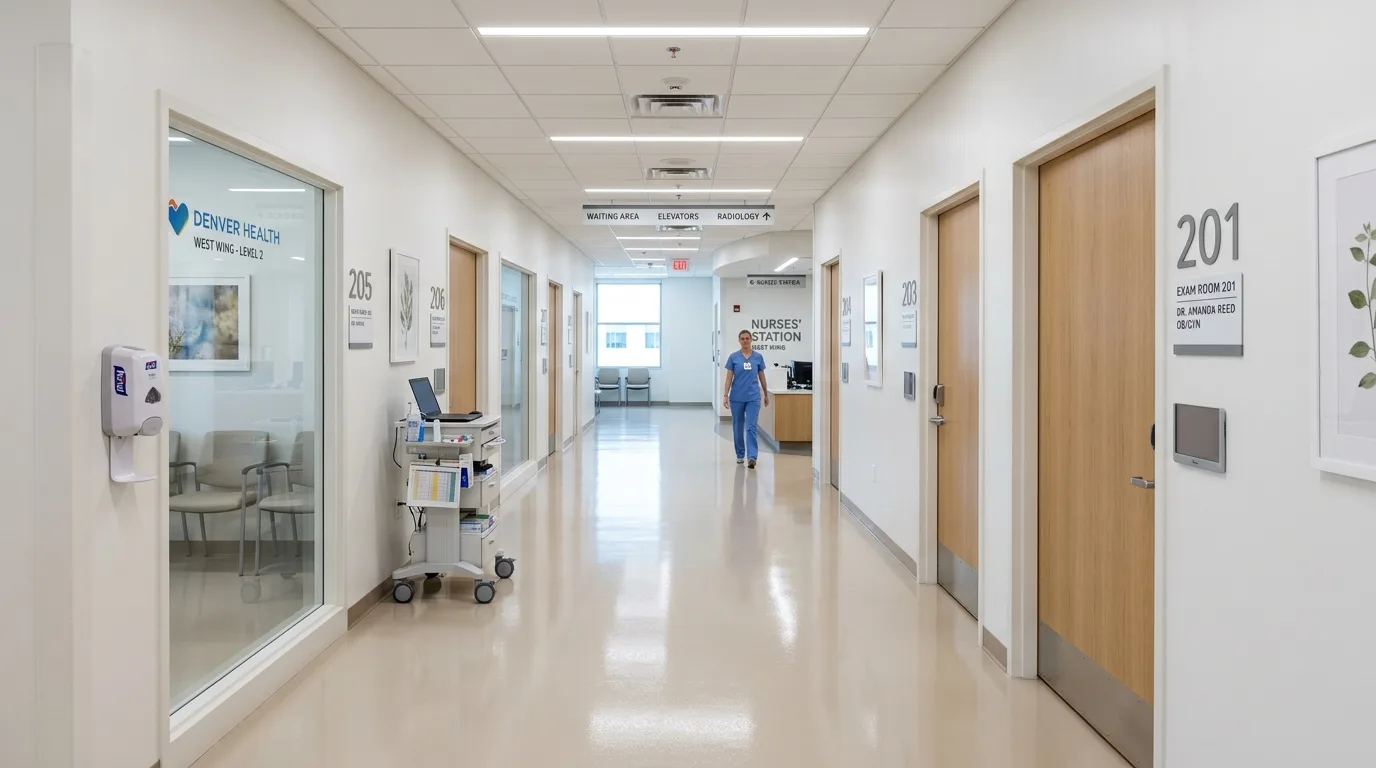
Why Medical Spaces Require Seamless Flooring
Standard commercial flooring — vinyl tile, sheet vinyl with seams, or grouted ceramic — fails one basic test in a healthcare environment: it has joints. Every grout line, seam, and edge is a harbor for pathogens, moisture, and cleaning chemical residue. In a clinical setting, that's not an aesthetic problem — it's an infection control failure. The CDC's Healthcare Infection Control Practices Advisory Committee (HICPAC) guidelines consistently point to flooring with no horizontal joints as the preferred substrate in areas where contamination risk is high.
Seamless epoxy flooring eliminates this problem entirely. A properly installed 100% solids epoxy system bonds monolithically to the concrete substrate — no seams, no grout lines, no edges where bacteria can survive cleaning cycles. The surface is impervious to the moisture and chemical splash that are constant in clinical environments, and cove base integration seals the wall-to-floor junction that is the most common contamination point in older healthcare facilities.
Denver's healthcare sector — anchored by the Anschutz Medical Campus, UCHealth, SCL Health, and dozens of outpatient and specialty clinic networks — has increasingly specified seamless epoxy for new builds and retrofits alike. At ProEpoxy Denver, we install hospital-grade systems throughout the Front Range, from Fitzsimons Life Science District clinics to suburban urgent care centers in Aurora, Lakewood, and Westminster.
Chemical Resistance in Denver Clinical Environments
Healthcare facilities use a specific and aggressive set of cleaning agents. Quaternary ammonium compounds ("quats"), sodium hypochlorite (bleach solutions up to 10,000 ppm), hydrogen peroxide vapor, and accelerated hydrogen peroxide products are all standard disinfection protocols in Denver hospitals and clinics. Each of these will degrade an inferior coating within months — causing delamination, surface yellowing, and loss of the seamless integrity that made the floor valuable in the first place.
Our healthcare epoxy systems use aliphatic polyaspartic topcoats specifically because aliphatic formulations resist both UV yellowing (important in daylit clinical spaces) and oxidative chemical attack. Unlike aromatic urethane topcoats — which are cheaper but turn yellow and chalk under disinfectant cycling — aliphatic polyaspartics maintain their appearance and chemical barrier properties through thousands of cleaning cycles.
Denver altitude note: At 5,280 ft, Denver's low atmospheric pressure slightly accelerates cure times for epoxy and polyaspartic systems. Walk-ready at 8–10 hours rather than the 12 hours specified in manufacturer data sheets calibrated at sea level. This is an advantage for overnight clinical installs — floors are typically accessible for the next business day's patient schedule.
Denver Medical Districts We Serve
Anschutz / Fitzsimons Life Science District (Aurora)
Colorado's largest medical research and clinical complex. We serve labs, outpatient clinics, and administrative support facilities throughout the campus. No travel surcharge from Denver.
Colorado Medical Center / Cherry Creek Medical (Denver)
Specialty clinic, surgery center, and outpatient rehabilitation facilities along E. Hampden and Cherry Creek corridors. Overnight and weekend installs standard.
St. Joseph / Presbyterian-St. Luke's Area (Denver)
Clinical support and ancillary facilities serving North Denver's hospital cluster. Phased installs available for active facilities with minimal operational disruption.
Suburban Health Networks (Westminster, Lakewood, Arvada)
Urgent care, physical therapy, dental, and specialty clinic retrofits across the west and north suburbs. Same-week scheduling within our standard service zone.
Compliance & Spec Requirements for Healthcare Floors
Healthcare flooring specifications increasingly reference third-party standards rather than simple descriptive requirements. When a facility's infection control committee or facilities manager asks for documented performance, we provide:
- ASTM F3010 — Standard Practice for Two-Component Resin Based Membrane Waterproofing
- ASTM F2170 — In-Situ Relative Humidity testing pre-install to confirm slab moisture is within coating tolerance
- ANSI A137.1 slip resistance — Dynamic Coefficient of Friction (DCOF) ≥ 0.42 wet for all clinical floor surfaces
- Low-VOC formulations — All healthcare installs use low-odor, low-VOC products compatible with occupied or adjacent-to-occupied installation
For ESD-sensitive areas — MRI support rooms, PACS workstation areas, electronics storage — we offer static-dissipative epoxy systems with surface resistance of 10⁶–10⁹ ohms per ANSI/ESD S20.20. These systems are installed concurrently with the standard floor to eliminate a separate trade mobilization.
| System | Typical Range | Best For |
|---|---|---|
| Seamless Clinical Epoxy | $6–$9/sqft | Corridors, exam rooms, utility |
| Lab-Grade Chemical Resistant | $8–$12/sqft | Labs, pharmacy prep, sterile areas |
| ESD Anti-Static Add-On | +$2–$4/sqft | MRI support, electronics areas |
| Cove Base Integration | $8–$14/lft | All clinical environments |
Frequently Asked Questions
Yes — we section off install areas and work around patient care schedules, including overnight and weekend windows to minimize operational impact. Low-odor formulations allow work adjacent to occupied spaces.
Hospital-grade disinfectants including bleach, quaternary ammonium compounds, and hydrogen peroxide must have zero effect on the coating. Our aliphatic polyaspartic topcoats are tested and rated against all three — and maintain that resistance through thousands of cleaning cycles.
Yes — the Fitzsimons Life Science District is within our standard service zone with no travel surcharge. We have installed floors throughout the Anschutz/Fitzsimons corridor, from research labs to outpatient clinic support spaces.
Explore our healthcare epoxy service page, review commercial epoxy options, or check our ESD anti-static flooring page for electronics-sensitive clinical areas.