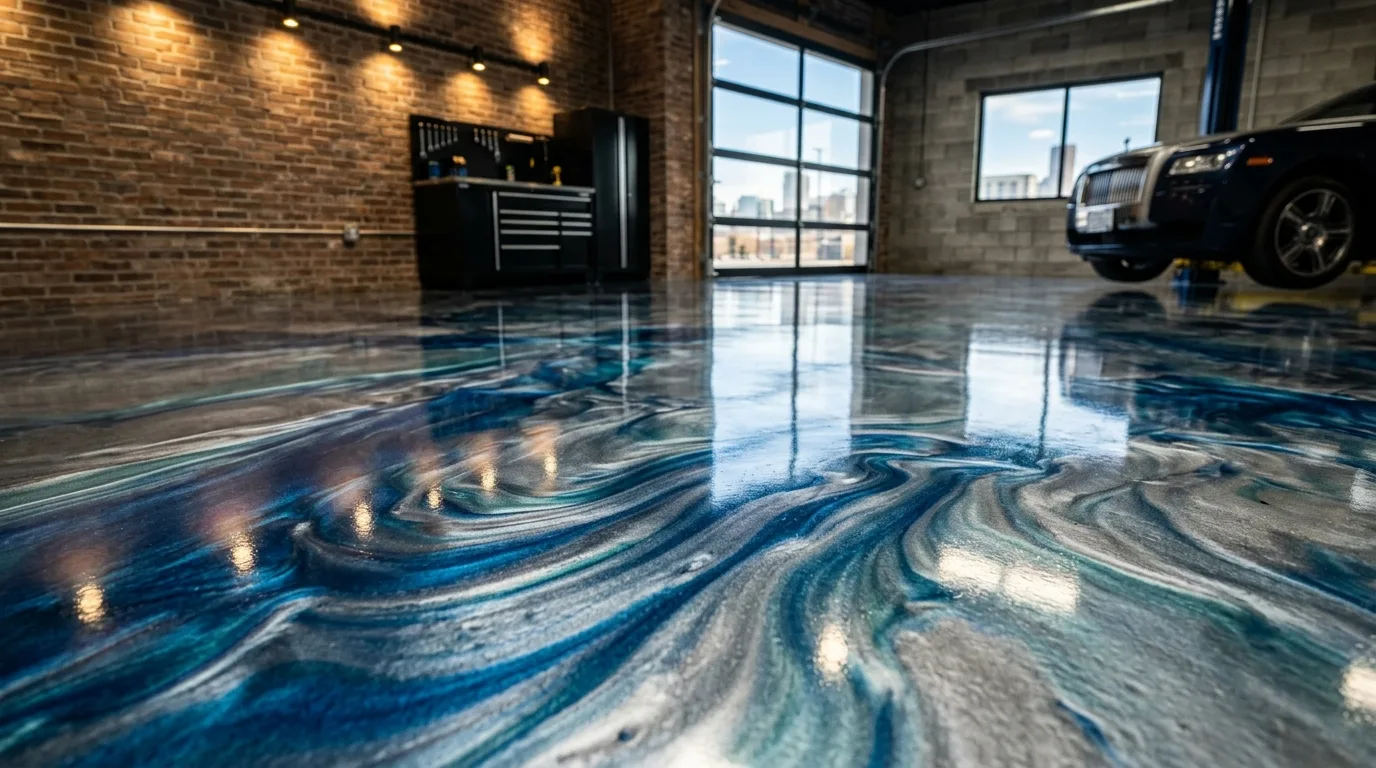
Metallic Epoxy Flooring Denver: Design Options, Costs & What to Expect
No two metallic epoxy floors look the same — the swirl, depth, and color combination are unique to each pour. Here's how the effect is created, what it costs in Denver, and what Colorado's climate requires from the topcoat.
Metallic epoxy creates the 3D depth effect that standard flake or solid-color epoxy can't replicate. The floor appears to have movement — waves, ripples, or swirling clouds of color suspended beneath a glass-like surface. In Denver, where metallic epoxy flooring has become popular in garages, showrooms, and finished basements, the challenge is ensuring the system holds up to altitude UV and freeze-thaw cycling without the topcoat yellowing. This guide covers the full picture.
Single Color$8 – $10 / sqft
Multi-Color$10 – $14 / sqft
Walk On24h · Drive 72h
How Metallic Epoxy Gets Its 3D Swirl Effect
The effect comes from metallic mica pigment suspended in a high-gloss epoxy base coat. The pigment particles are flat and reflective — like microscopic mirrors. When the wet epoxy is manipulated with tools, compressed air, or hand movement, the particles rotate and orient at different angles. Light reflecting off pigment at different depths and angles creates the illusion of three-dimensional movement.
1
Diamond Grind & Primer
Day of install — morning
Standard CSP-2 diamond grinding and epoxy primer. Moisture testing done the day before or morning of. The primer coat must reach the correct tack level before metallic application — timing is critical, especially at Denver's altitude where cure windows differ from sea level.
2
Metallic Base Coat Application
Applied while primer is at correct tack
Mixed metallic epoxy is poured and spread across the floor. The installer works quickly — metallic epoxy has a shorter working time than standard epoxy. Color placement, blending, and initial manipulation happen in this window.
3
Pigment Manipulation
20–40 min while wet
Compressed air, squeegees, brushes, and rollers manipulate the wet pigment to create swirls, waves, and depth effects. This is where the design comes from — no two floors are identical. Multi-color designs have a second pigment introduced while the first is still workable.
4
Aliphatic Polyaspartic Topcoat
After base cure — 2 coats
Two coats of UV-stable aliphatic polyaspartic seal the design. This topcoat is non-negotiable for Denver metallic installs — standard aromatic epoxy topcoat yellows the metallic pigment within one Colorado summer. The polyaspartic stays crystal-clear at altitude and withstands freeze-thaw cycling without micro-cracking.
Popular Metallic Color Combos in Denver
Color choice is the most personal part of metallic epoxy. Denver clients most often select:
🌊
Ocean Blue + Silver
The most requested combination. Deep navy or teal base with silver highlights creates a water or aurora effect. Works in garages, basements, and fitness rooms.
🥈
Charcoal + Gunmetal
Subtle and masculine. Dark charcoal base with gunmetal silver creates a matte-metallic look that photographs well in automotive and tool-focused garages.
🥇
Pearl + Champagne
Light and warm — popular for finished basements and home gyms. Pearl white base with champagne gold highlights creates an upscale travertine-like appearance.
🟤
Copper + Bronze
Warm industrial palette popular in Denver's Highlands and RiNo aesthetic. Copper base with dark bronze creates depth that pairs well with exposed brick and wood beam interiors.
Ocean blue and silver metallic epoxy with double polyaspartic topcoat — one of the most requested combinations in Denver.
Metallic Epoxy for Garages vs Commercial Showrooms
The system is similar — the difference is in spec, build thickness, and topcoat layers.
Denver-specific requirement: Every metallic epoxy system ProEpoxy installs in Denver uses an aliphatic polyaspartic topcoat — not a standard epoxy topcoat. Standard topcoats contain aromatic chemical bonds that Denver's high-altitude UV destroys within one summer, yellowing the metallic pigment permanently. Aliphatic polyaspartic stays optically clear at 5,280 feet and remains flexible through 155+ annual freeze-thaw cycles.
Cost of Metallic Epoxy vs Standard Epoxy in Denver
Metallic epoxy costs more than standard flake for three reasons: the metallic mica pigment is more expensive than broadcast flake, the application window is tighter and requires a more skilled installer, and multi-color designs add material and time. The result is a one-of-a-kind floor that a flake system can't replicate.
Frequently Asked Questions
How much does metallic epoxy cost in Denver?
$8–$14 per sqft installed depending on design complexity, color count, and slab prep required. Single-color metallic with standard prep runs $8–$10/sqft. Multi-color custom designs with crack repair can reach $12–$14/sqft.
Does metallic epoxy hold up in Denver garages with road salt?
Yes — all ProEpoxy metallic systems are sealed with a UV-stable aliphatic polyaspartic topcoat rated for deicer and magnesium chloride contact. The topcoat also prevents the base coat from yellowing under Denver's high-altitude UV.
Can I choose custom colors?
Yes — we offer dozens of metallic pigments in our standard palette including pearl, silver, gold, copper, ocean blue, charcoal, and champagne. Custom pigment blends are available on request for exact color matching.
Ready to Design Your Denver Metallic Epoxy Floor?
Free on-site design consultation — color samples, slab assessment, system recommendation. We install across Denver, Aurora, Lakewood, Westminster, Arvada, and Thornton.