Warehouse Epoxy Flooring Denver: Heavy-Duty Systems for Colorado's Front Range
Denver warehouse floors take punishment from forklifts, road salt, freeze-thaw cycling, and continuous industrial traffic. Here's what a correctly specified industrial epoxy system looks like — and what shortcuts cost you.
A warehouse floor in Denver faces demands that separate industrial epoxy from residential epoxy fast. Forklifts, pallet jacks, chemical spills, road salt tracked in from I-70 and I-76, and the same freeze-thaw cycling that damages residential concrete all concentrate on a slab that has to stay operational. This guide covers the right system for Denver warehouse conditions, how to install in a working facility without shutting down operations, and which Front Range industrial corridors we serve for warehouse epoxy flooring in Denver.
Industrial System$5 – $9 / sqft
Forklift-Rated20-mil min. + polyaspartic
Phased Install10–15k sqft / phase
What Makes a Good Warehouse Floor System in Colorado
A Denver warehouse floor coating has to meet requirements that residential and light commercial systems cannot satisfy. The combination of heavy load, chemical exposure, and Colorado's climate demands a system specified for all three — not just the first one.
🏋️
Load & Impact Rating
Standard warehouse epoxy systems are rated for forklifts up to 8,000 lbs capacity. Heavy-load facilities running 10,000+ lb equipment require a self-leveling epoxy base coat at 1/8 inch thickness before broadcast and topcoat.
🧪
Chemical Resistance
100% solids epoxy resists hydraulic fluid, motor oil, diesel, battery acid, and cleaning chemicals. For facilities handling aggressive chemicals, we specify solvent-resistant epoxy formulations with tested chemical compatibility.
🧂
Road Salt & Mag Chloride
Colorado's mag chloride deicing program is aggressive. Loading dock approaches and entrance areas tracked with deicer require polyaspartic topcoat specifically rated for mag chloride contact — standard epoxy topcoats blister within one season.
❄️
Freeze-Thaw at Loading Docks
Loading dock transitions — where exterior meets interior slab — are highest-risk for freeze-thaw delamination. Flexible primer and a polyaspartic topcoat that remains pliable below freezing is the only system that survives Denver winters at dock edges.
Forklift-Rated vs Standard Epoxy
Not all epoxy is rated for industrial traffic. The difference is in system thickness, substrate prep, and topcoat selection — not just the base coat product.
System
Thickness
Forklift Rating
Cost / Sq Ft
Light CommercialBroadcast flake + polyaspartic
12–15 mil
Up to 5,000 lb
$4 – $6
Standard IndustrialHeavy broadcast + polyaspartic
20–25 mil
Up to 8,000 lb
$5 – $8
Heavy IndustrialSelf-leveling base + broadcast + polyaspartic
1/8 in + topcoat
10,000+ lb
$7 – $12
Safety Striping Add-OnOSHA aisle marking, dock zones
—
—
$0.50 – $1.50
Substrate prep determines durability, not product brand. A premium epoxy applied over an acid-etched slab delaminate from forklift traffic within 12–18 months. Diamond grinding to CSP-3 (the roughness required for industrial bond) is non-negotiable for any forklift-traffic area. ProEpoxy uses shot blasting or dual-drum diamond grinding on all industrial installs — never acid etch.
Denver Warehouse Districts We Serve
ProEpoxy crews operate seven days a week across the Denver metro industrial footprint. We're familiar with the specific logistics constraints in each district — loading dock scheduling, after-hours access, union crew coordination requirements.
🏭
Commerce City & I-76
Denver's primary heavy industrial corridor — refinery support, distribution, manufacturing. We serve the entire Commerce City industrial district including Brighton Road and I-76 frontage facilities.
🚛
Globeville & I-70 East
High-density logistics and 3PL facilities east of I-25. The I-70 RINO and Globeville industrial cluster has active 24/7 facilities — we schedule overnight sections to maintain operational continuity.
📦
Henderson & Brighton
North metro distribution and manufacturing — including large-format fulfillment centers and cold-chain adjacent facilities. Phase scheduling available for 100,000+ sqft projects.
🔩
Englewood & Centennial
South metro manufacturing and light industrial — aerospace component, medical device, and precision fabrication facilities. We've coated floors in certified clean-room adjacent areas.
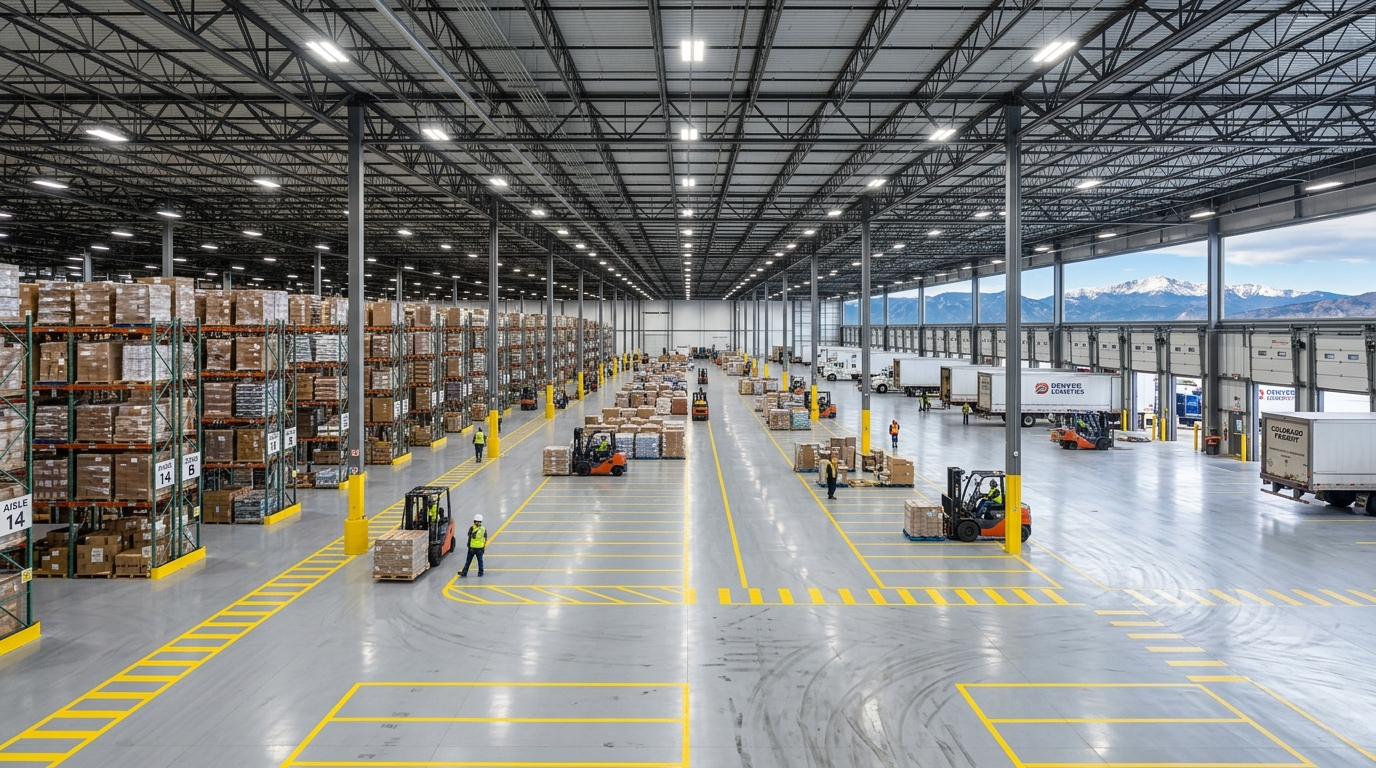
Standard industrial epoxy system with OSHA safety striping — seamless gray with yellow aisle and dock zone markings.
Installation Timeline for Large Warehouse Projects
Large-format warehouse installs are scheduled in phases to keep operations running. ProEpoxy plans every phased install around your facility's operational windows — not the other way around.
1
Section Phasing Plan
Before scheduling
We walk the facility with your operations team and map sections by operational priority. Typically 10,000–15,000 sqft per phase, sequenced so the installation crew never shuts down more than 20–25% of the floor at once. Phase boundaries are marked with temporary safety barriers.
2
Overnight & Weekend Windows
Per facility schedule
Diamond grinding and coating crews work overnight or weekend shifts for operational facilities. At Denver's altitude, overnight temperatures affect open-time windows — we adjust product selection seasonally so cold nights don't extend cure times beyond operational return windows.
3
12-Hour Walk-Ready, 48-Hour Forklift-Ready
Per completed section
Polyaspartic topcoat allows foot traffic return in 12 hours — crews can re-enter the completed section the following morning shift. Forklift traffic returns at 48 hours. For facilities that cannot wait 48 hours, we specify fast-cure polyaspartic systems rated for earlier return-to-service.
Frequently Asked Questions
How long does a warehouse floor take to install?
3,000–5,000 sqft typically takes 2 days. Larger projects are scheduled in sections — typically 10,000–15,000 sqft per phase — to keep warehouse operations running during installation.
What coating handles road salt tracked in from Denver winters?
Polyaspartic topcoat rated for deicer and magnesium chloride contact is the correct choice for Colorado warehouse entrances, loading docks, and high-traffic lanes where winter road chemicals are tracked in daily.
Do you work in the Commerce City and Brighton industrial corridors?
Yes — we serve all Denver metro industrial zones including the I-76 and I-70 corridors, Commerce City, Brighton, Henderson, and the Globeville industrial district. Scheduling available 7 days a week for operational facilities.
Ready to Coat Your Denver Warehouse Floor?
Free facility walk-through — section mapping, phase planning, system spec. We schedule around your operational hours across the entire Denver metro and Front Range.