Why Denver Basements Need Moisture Vapor Barriers
Denver's reputation as a dry city can create a false sense of security when it comes to basement moisture. While average relative humidity is 35–45% — far lower than coastal cities — basement slabs present a different moisture dynamic. Concrete is porous, and the soil surrounding a basement slab often holds residual moisture from snowmelt, spring rain, and subsurface water movement. This moisture migrates upward through the slab as water vapor, a process called vapor drive.
Without a moisture vapor barrier primer, vapor pressure can interfere with epoxy adhesion and cause blistering or delamination — the coating lifts in bubbles as trapped moisture expands beneath it. This failure mode looks dramatic and is entirely preventable with proper testing and primer selection.
Denver-specific factors that increase basement vapor risk:
- Spring snowmelt — rapid warm-up in March and April saturates Front Range soils, temporarily elevating vapor emission rates even in basements that test dry in summer
- Platte River valley and low-lying areas — basements in areas like Globeville, Elyria-Swansea, and parts of South Denver near natural drainages have higher baseline moisture exposure
- Older homes with no drainage membrane — pre-1990 Denver construction often lacks modern waterproofing details, meaning slab moisture levels vary seasonally
- Finished basement conversions — previously carpeted basements may have elevated slab moisture content from years of trapped vapor under the carpet pad
Our process: Every basement assessment includes a calcium chloride test (ASTM F1869) left in place for 60–72 hours before any coating work begins. If the reading exceeds 3 lbs/1,000 sqft/24h, we apply a moisture-mitigating epoxy primer before the decorative base coat. This adds one day to the schedule and $0.50–$1.00/sqft to the project cost — far less than remediating a failed coating.
Finish Options for Denver Basement Floors
Basement Epoxy vs Polished Concrete in Colorado
Both epoxy and polished concrete are excellent choices for Denver basements. The decision usually comes down to the slab's condition and the intended use:
- Epoxy is better when the slab has significant cracks, surface pop-outs, or previous coatings. Epoxy fills and hides surface defects that polishing would expose. Also better for spaces requiring color customization or a non-reflective matte finish.
- Polished concrete is better when the slab is in good condition and you want a high-gloss look with minimal sheen variation. Polishing removes the top layer of concrete rather than covering it, producing a more durable surface in high-traffic spaces over very long timescales (20+ years).
- Cost difference — standard solid-color epoxy is typically $3–$5/sqft for a basement, while diamond-polished concrete runs $4–$8/sqft depending on grit level. The gap narrows when comparing decorative epoxy (flake, metallic) to standard polish.
Cost of Basement Epoxy in Denver
| System | Typical Range | Best For |
|---|---|---|
| Solid color epoxy (no moisture issue) | $3–$5/sqft | Utility, storage, gym |
| Solid color + moisture barrier primer | $4–$6/sqft | Older homes, high vapor |
| Decorative flake system | $4–$6/sqft | Finished basement, playroom |
| Metallic epoxy | $6–$9/sqft | Entertainment room, bar area |
| Grip aggregate add-on | +$0.50/sqft | Home gym floors |
A typical Denver finished basement (600–1,000 sqft) runs $2,400–$9,000 depending on finish level and whether moisture mitigation is required. Free on-site assessment includes the calcium chloride test and a firm quote before any work begins.
Installation Process
Moisture Test (60–72 hrs)
Calcium chloride kit placed on the slab and sealed. We return to read results after 60–72 hours. This step cannot be shortened — results obtained in 24 hours are unreliable. We schedule this before any surface prep so the project timeline doesn't extend unnecessarily.
CSP-2 Diamond Grinding
Commercial Shotblast Profile 2 (CSP-2) grind opens the concrete surface for adhesion. Basement slabs are typically newer and harder than garage slabs — diamond tooling is selected for the specific concrete hardness. Cracks and spalls are filled with polyurea joint filler.
Moisture Barrier Primer (if needed)
If calcium chloride test exceeds threshold, moisture-mitigating epoxy primer is applied and allowed to cure 12–24 hours. This layer chemically bonds with residual moisture and creates a sealed surface for the decorative system above.
Base Coat + Decorative Finish + Topcoat
100% solids epoxy base coat applied, decorative system (flake, metallic, solid) installed, polyaspartic topcoat applied. Walk-on in 6–8 hours. Light furniture placement in 24 hours. Full cure in 72 hours. Total install typically completes in one day for most basements.
Frequently Asked Questions
We use a calcium chloride test (ASTM F1869); under 3 lbs/1,000 sqft/24h is acceptable for standard epoxy. Higher readings require a moisture vapor barrier primer before the base coat. Most Denver basements pass — the dry climate keeps vapor emission rates low — but below-grade slabs near the water table in areas like the Platte River valley sometimes need mitigation.
Not from freeze-thaw if properly installed — the basement slab is protected from exterior thermal cycling by the surrounding soil and foundation mass. Unlike garage floors that are directly exposed to temperature swings, basement slabs experience minimal temperature fluctuation. The primary risk in basements is moisture vapor, not freeze-thaw.
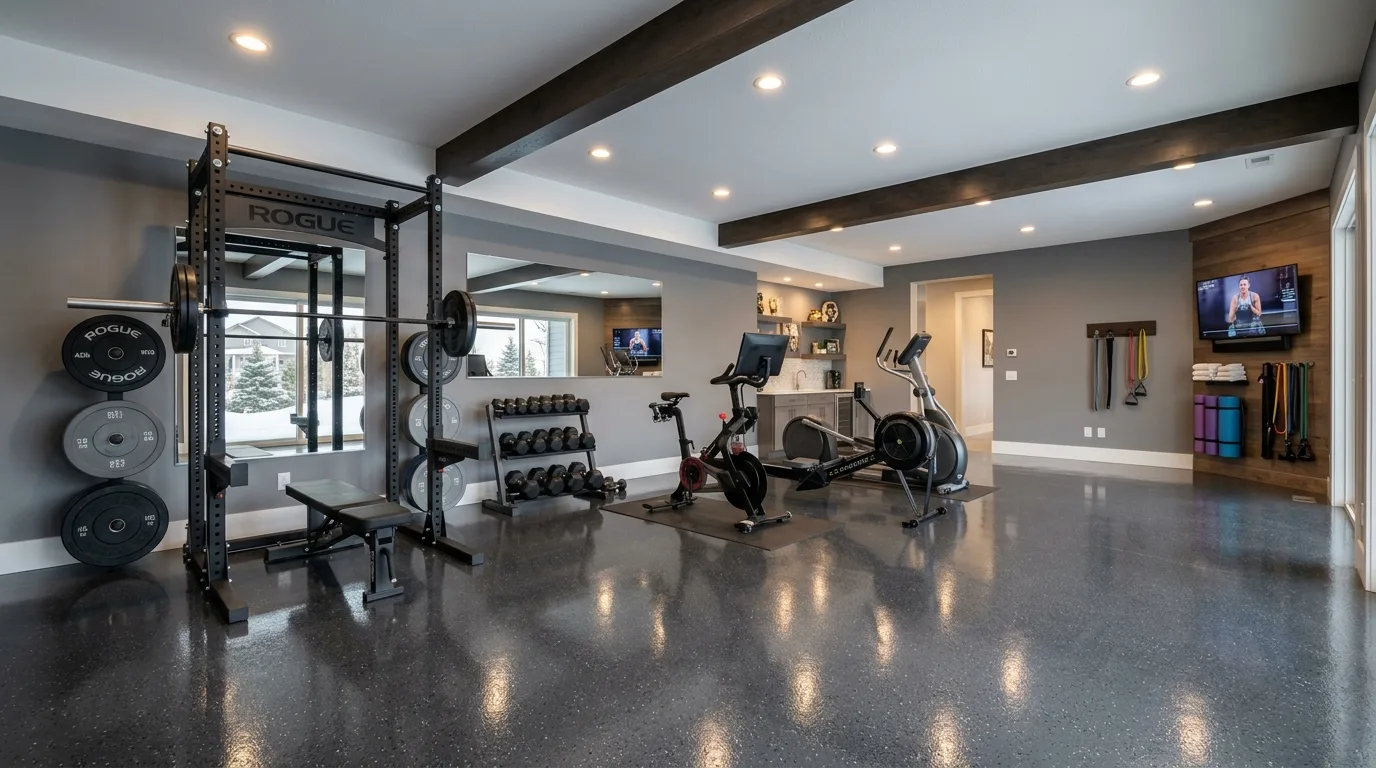
Yes — seamless epoxy is one of the best gym floor substrates. We add aluminum oxide or silica aggregate to the topcoat for grip under rubber mats and bare feet. The seamless surface is easy to clean after heavy workouts and handles dropped weights better than tile or vinyl. Most gym basement installs include the grip aggregate add-on at no significant extra cost.
See the basement epoxy service page for full specs, or explore residential epoxy and garage epoxy options.