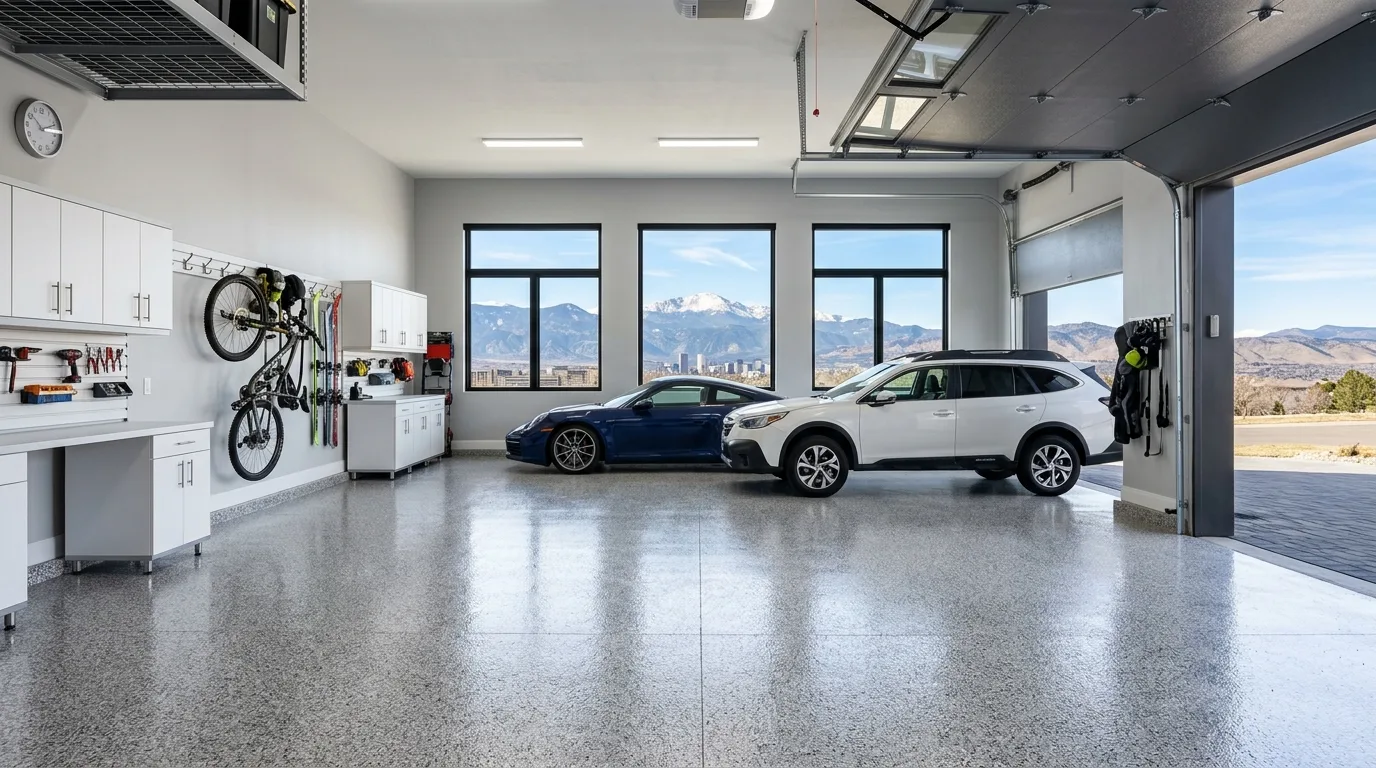
What Makes Polyaspartic Different From Epoxy
Polyaspartic is an aliphatic polyurea — a chemistry class that shares epoxy's bond strength and chemical resistance but adds two properties that matter enormously for Denver's environment: UV stability and faster cure kinetics. Standard epoxy topcoats are aromatic compounds that absorb UV radiation and oxidize, producing the characteristic amber yellowing seen on garage floors after one or two Colorado summers. Aliphatic polyaspartic does not have this weakness.
The practical differences for a Denver garage or commercial floor:
- No UV yellowing — maintains its original color indefinitely under Colorado's high-altitude solar radiation
- Faster return to service — walk-on in 4–6 hours versus 12–24 hours for standard epoxy topcoats
- Higher flexibility — better accommodates the micro-movement that Denver's freeze-thaw cycles create in concrete slabs
- Temperature application window — can be applied in cooler temperatures than epoxy, extending Denver's installation season into early spring and late fall
- Chemical resistance — rated for road salt, mag chloride, petroleum products, and hot tire pickup resistance
The tradeoff is cost: polyaspartic materials run 20–30% more than epoxy topcoats, and the faster cure window requires more experienced installers who can work efficiently before the coating gels. In Denver's climate, the UV and freeze-thaw benefits consistently make polyaspartic the better long-term investment for exposed garage and outdoor-adjacent floors.
Why UV Stability Matters at Denver's 5,280 ft Altitude
Denver receives roughly 300 days of sunshine per year, and at 5,280 feet above sea level, UV radiation intensity is approximately 25% higher than at sea level. This matters for floor coatings because standard epoxy topcoats use aromatic chemistry that reacts with UV radiation through a process called photooxidation — breaking molecular bonds and producing yellow and orange-tinged byproducts that accumulate in the coating layer.
Colorado UV reality: A standard epoxy topcoat installed on a Denver garage floor facing south will show visible yellowing within 12–18 months. By year three, the floor looks noticeably different than when installed. Polyaspartic avoids this entirely — it uses aliphatic chemistry that does not react with UV in the same way, maintaining the original color through 10+ years of Colorado sun exposure.
The UV issue is compounded in Denver by the low humidity environment. In humid climates, surface moisture provides some buffering against UV degradation. Denver's average relative humidity of 35–45% means coatings get the full UV dose without atmospheric mitigation. Polyaspartic is the correct chemistry for this environment.
Freeze-Thaw Resistance for Colorado Winters
Denver's climate creates a punishing freeze-thaw environment for floor coatings. The city averages 155 freeze-thaw cycles per year — days where temperatures cross the 32°F threshold — significantly more than most major U.S. cities. Each cycle causes the concrete slab to expand and contract slightly. Over hundreds of cycles, this micro-movement stresses the bond between coating layers and the concrete substrate.
Rigid epoxy topcoats handle early cycles well but develop micro-cracks along aggregate boundaries as cycles accumulate. These cracks allow moisture infiltration, which then freezes and expands, accelerating delamination. The process is gradual but consistent — most standard epoxy topcoats on Denver garage floors need recoating within 4–6 years.
Polyaspartic's higher elongation at break (typically 40–60% vs. 5–15% for rigid epoxy) allows it to flex with the slab through each cycle rather than cracking. Combined with proper surface preparation at CSP-3 diamond grind, a polyaspartic topcoat in Denver typically delivers 8–12 years before any maintenance recoat is needed.
Cost of Polyaspartic vs Epoxy in Denver
| System | Typical Range | Est. Topcoat Lifespan (Denver) |
|---|---|---|
| Epoxy base + standard epoxy topcoat | $3–$5/sqft | 3–5 years before UV yellowing |
| Epoxy base + polyaspartic topcoat | $4–$7/sqft | 8–12 years, UV-stable |
| Full polyaspartic system (base + top) | $5–$9/sqft | 10–15 years, maximum performance |
| Polyaspartic with decorative flake | $6–$10/sqft | 10–15 years, slip-resistant finish |
For a standard 500 sqft Denver two-car garage, a polyaspartic system typically runs $2,500–$5,000 installed. The 20–30% premium over base epoxy systems pays for itself by eliminating one recoat cycle over a 10-year period — most epoxy recoats run $1,500–$3,000 for a standard garage.
Installation Process
CSP-3 Diamond Grinding
Commercial Shotblast Profile 3 (CSP-3) opens the concrete pores for maximum mechanical adhesion. Required for polyaspartic systems — the faster cure window leaves no room for bond failure from inadequate prep. Cracks and spalls repaired with polyurea joint filler before coating.
Moisture Test & Primer
Denver's low humidity creates an unusual situation: vapor transmission rates are generally low, but basement and below-grade slabs can still have moisture issues. Calcium chloride or RH probe test determines if a moisture-mitigating primer is needed before the polyaspartic base coat.
Polyaspartic Base Coat + Broadcast
100% solids polyaspartic base applied and decorative flake or quartz broadcast immediately. Faster gel time than epoxy — installers must work efficiently in sections. Aggregate broadcast creates the slip resistance profile and decorative finish.
Polyaspartic Topcoat Seal
Aliphatic polyaspartic topcoat locks aggregate and provides UV and chemical resistance. Walk-on in 4–6 hours at Denver's altitude. Light vehicle traffic within 24 hours. Full chemical cure in 48–72 hours. No forced waiting through multi-day cure windows like standard epoxy systems require.
Frequently Asked Questions
No — aliphatic polyaspartic is UV-stable and won't amber or yellow, even with Colorado's intense high-altitude UV. Standard epoxy topcoats will yellow within one to two seasons in Denver's UV environment; polyaspartic will not. This is the primary reason we specify polyaspartic topcoats on all Denver garage floors.
Yes — polyaspartic is rated for repeated freeze-thaw cycling, making it the correct topcoat choice for Colorado garages that experience 155+ freeze-thaw cycles per year. Its higher elongation at break prevents the micro-cracking that rigid epoxy topcoats develop over time under the same thermal stress.
Typically 20–30% more than a base epoxy system. The offset is longer topcoat lifespan in Colorado conditions — a polyaspartic topcoat in Denver typically lasts 8–12 years versus 3–5 years for a standard epoxy topcoat before UV yellowing or surface dulling requires recoating. One avoided recoat pays for the premium several times over.
See the polyaspartic service page for full specs, or compare options with our garage epoxy and polyurea coating guides.