Commercial flooring decisions carry more weight than residential ones — downtime costs revenue, and the wrong system means a repeat project within a few years instead of a couple of decades. This guide covers what Denver business owners actually need to evaluate: which epoxy system fits which type of space, how installs get scheduled without shutting the business down, and what the real cost per square foot looks like by industry. It's the same framework ProEpoxy uses when specifying commercial epoxy flooring in Denver for every client.
Why Denver Businesses Choose Epoxy Flooring
Commercial spaces put more stress on a floor in a month than a residential garage sees in a year — foot traffic, rolling equipment, chemical spills, and constant cleaning cycles all compound. Epoxy systems are the standard answer because a properly specified coating is seamless (no grout lines to trap dirt or bacteria), chemically resistant, and dramatically easier to maintain than tile, VCT, or bare sealed concrete. For Denver specifically, that durability has to be paired with UV stability and freeze-thaw resistance at any entry point exposed to the outdoors — loading docks, vestibules, and garage-adjacent retail space all need the same altitude-rated system as a residential garage.
The other driver is total cost of ownership. A correctly installed commercial epoxy floor requires no waxing, no periodic resealing, and minimal downtime for cleaning — over a 10-15 year period that adds up to real savings against flooring options with higher maintenance overhead.
System Types for Commercial Spaces
Not every commercial space needs the same system, and specifying the wrong one is either an overspend or an early failure. Matching system to space starts with two questions: what's rolling or walking across the floor, and what's it exposed to chemically. A boutique retail floor and a distribution center both want epoxy, but the mil thickness, aggregate broadcast, and topcoat chemistry are entirely different once you account for forklift traffic versus foot traffic, or degreaser exposure versus routine mopping. Here's how we match system to space type across the categories we see most often in the Denver metro.
Scheduling Installs Around Business Hours
The biggest concern we hear from commercial clients isn't the floor itself — it's downtime. A retail store or office can't close for a week, and a restaurant can't shut its kitchen for two days without losing revenue. The good news: most commercial epoxy installs don't require full closure if the schedule is planned correctly.
We typically phase larger commercial floors into sections, working nights or weekends so the business stays open during regular hours. Aliphatic polyaspartic topcoats are the enabling factor here — they cure fast enough (walkable in 4-6 hours) that a section coated Friday night can often take light foot traffic by Saturday morning. For spaces that truly can't tolerate any interruption, we schedule the full install over a single closed weekend rather than spreading it across multiple partial-access days, which minimizes the total disruption window even though it means one longer closure.
Plan ahead on scheduling: The earlier we're brought in during your renovation or buildout timeline, the more phasing options are available. Last-minute scheduling limits us to whatever nights or weekends are open, which can push the project out further than planned.
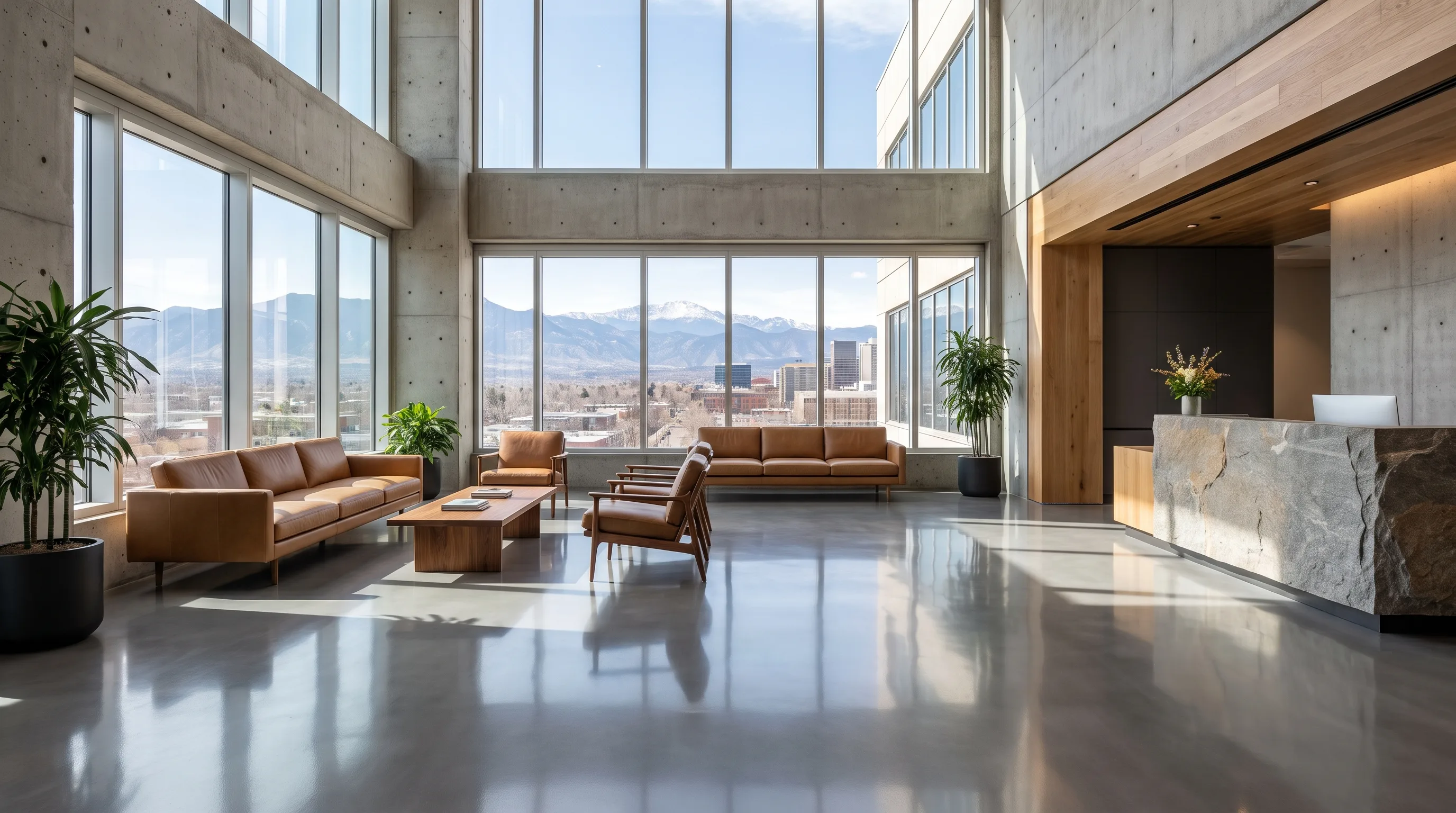
A seamless commercial epoxy floor in a Denver office lobby — solid color system, moderate-traffic rated.
Cost Per Square Foot by Industry
Commercial pricing varies more than residential because the system requirements vary so much by use case. Here's what to expect across the industries we work with most in the Denver metro.
| Industry / Space Type | System | Cost / Sq Ft |
|---|---|---|
| Retail & OfficeSolid color or quartz blend | Standard commercial | $5 – $7 |
| Restaurant & KitchenSlip-resistant, NSF-compliant | Textured urethane/epoxy | $7 – $10 |
| Gyms & FitnessImpact and moisture resistant | Reinforced epoxy | $6 – $9 |
| Light IndustrialForklift-rated broadcast | Heavy-duty broadcast | $8 – $12 |
Maintenance and Return on Investment
The financial case for commercial epoxy comes down to what you're not paying for over the life of the floor. Tile grout needs regular deep cleaning and eventually re-grouting. VCT needs stripping and waxing on a recurring schedule. Sealed bare concrete needs periodic resealing and still dusts and stains. A correctly installed epoxy system needs none of that — daily maintenance is a dust mop or auto-scrubber, and periodic maintenance is an occasional degreaser pass in kitchens or a burnish in high-traffic retail aisles.
Over a 10-year period, that maintenance gap is often the larger cost difference versus the upfront install price, especially for spaces with continuous foot traffic like retail floors or gyms. It's also a factor in lease negotiations and property valuations — a documented, durable floor system is an asset a commercial tenant or owner can point to, not a recurring line item in the maintenance budget.
Denver's climate adds one more consideration specific to this market: any space with an exterior-facing entrance, loading dock, or garage-adjacent showroom sees the same UV and freeze-thaw exposure as a residential garage. Businesses that install a standard epoxy system without the altitude-rated polyaspartic topcoat often find themselves budgeting for a full recoat within 3-5 years — well short of the 10-20 year lifespan a correctly specified system delivers, and an unplanned expense that a proper initial spec avoids entirely.
Choosing the Right Contractor for a Commercial Job
Commercial epoxy work has a lower margin for error than residential — a botched garage floor is an inconvenience, a botched retail or restaurant floor is lost revenue during the redo. A few things separate a commercial-capable contractor from one that only handles residential garages:
- In-house crews, not subcontractors. Commercial timelines depend on schedule reliability. A crew that's actually employed by the company you hired is accountable to that schedule in a way a subcontractor chain isn't.
- Experience phasing around live operations. Sectioning a floor to keep part of a business open is a different skill than a single-pass residential install — ask for references from similar-sized commercial jobs.
- Correct system knowledge by use case. A contractor should be recommending the system based on your traffic and chemical exposure, not defaulting to whatever they install most often.
- Colorado-specific material selection. Any exterior-adjacent commercial floor still needs UV-stable, freeze-thaw-rated materials — the same requirement that applies to residential garages in Denver's climate.
- A written scope before work starts. A commercial proposal should specify prep method, mil thickness, topcoat product, and phasing plan in writing — not a verbal estimate you can't hold the contractor to if the finished floor doesn't match what was discussed.
Getting these right up front is far cheaper than a redo. A commercial floor that fails early doesn't just cost the price of the second install — it costs a second round of business disruption, which is usually the more expensive part of the equation.