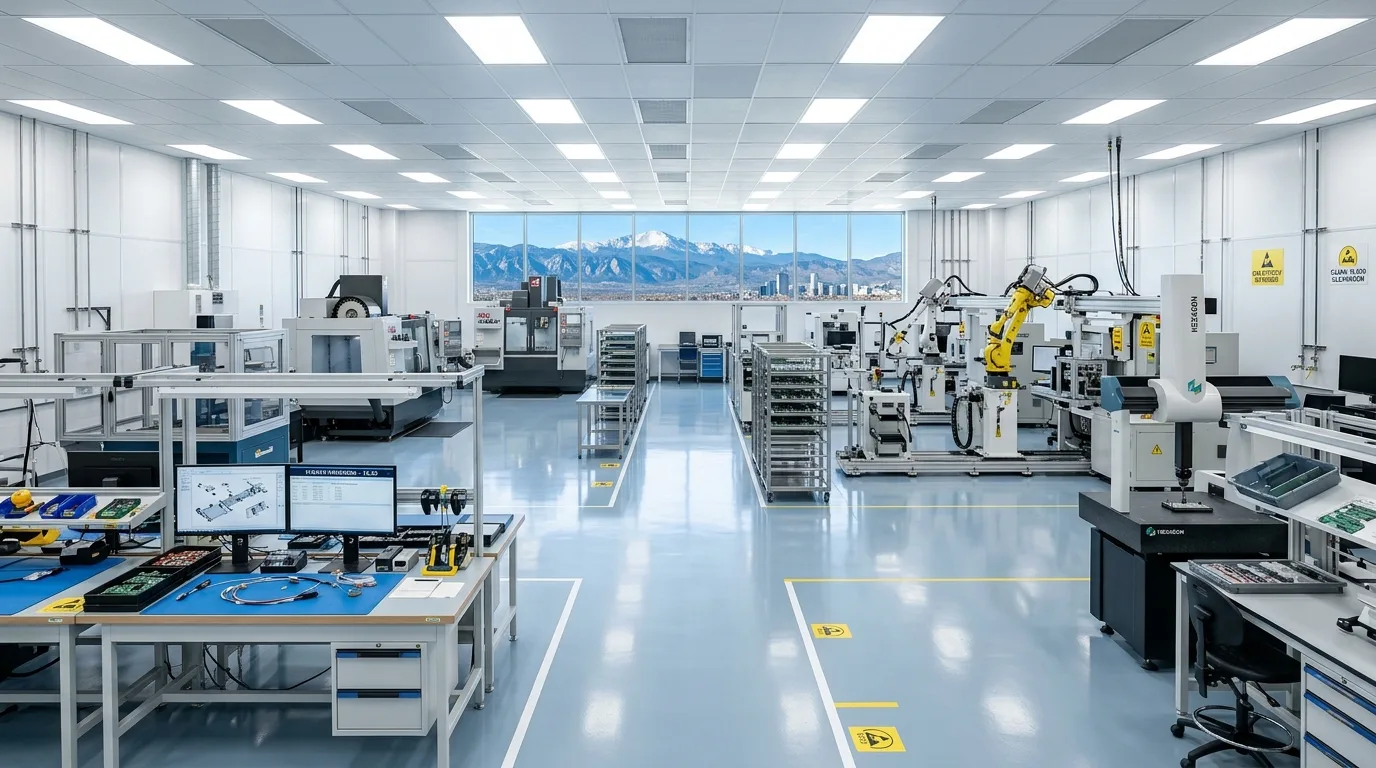
Static electricity destroys sensitive electronics silently — a single uncontrolled discharge can degrade a component without any visible sign of damage, only to fail in the field months later. For Denver's dense aerospace, defense, and electronics manufacturing sector, ESD-compliant flooring isn't optional — it's a documented, testable requirement. And Colorado's dry climate makes the risk worse than in most other states. See our ESD anti-static epoxy service page for compliance specs.
What ESD Flooring Does and Why It Matters
Electrostatic dissipative (ESD) epoxy flooring is engineered with conductive additives — typically carbon or metallic particulate — that create a controlled path to ground for static charge. Rather than allowing charge to build up on personnel or equipment and discharge suddenly (electrostatic discharge, or ESD event), the floor continuously bleeds off static at a safe, controlled rate.
Controlled Discharge
Conductive carbon or metallic additives create a continuous path to ground, preventing sudden static discharge events near sensitive components.
Component Protection
Protects semiconductors, circuit boards, and precision electronics from latent ESD damage that may not manifest until months after exposure.
Auditable Compliance
Provides documented ANSI/ESD S20.20 compliance for facilities working under defense contracts, aerospace certifications, or ISO manufacturing standards.
Colorado-Calibrated
Denver's low humidity accelerates static buildup. Our ESD systems are specified and tested for Colorado's dry-climate conditions, not generic sea-level assumptions.
ANSI/ESD S20.20 Compliance Explained
ANSI/ESD S20.20 is the industry-standard program for developing an ESD control program, and flooring is one of its most heavily specified elements. The standard requires flooring systems to maintain resistance-to-ground (RTG) between 1.0 x 10⁴ and 1.0 x 10⁹ ohms, and resistance-point-to-point (RTPP) within similar bounds, verified with calibrated test equipment.
Meeting the standard isn't just about installing "ESD epoxy" off a shelf — it requires correct primer selection, conductive copper grounding strips tied into facility grounding, proper additive ratio in the topcoat, and post-install testing to confirm compliance across the entire floor area, not just spot checks.
Denver and Colorado Industries That Require ESD Floors
Colorado's Front Range hosts one of the largest aerospace and defense industry clusters in the United States, driving consistent demand for certified ESD flooring across multiple sectors.
- Aerospace and defense contractors: Lockheed Martin, Raytheon, Ball Aerospace, and their supply chain all require ESD-controlled work areas.
- Electronics manufacturing: PCB assembly, component testing, and precision electronics production facilities.
- Semiconductor and photonics: Cleanroom-adjacent manufacturing and testing environments.
- Data centers: Server rooms and network infrastructure facilities where static discharge risks hardware failure.
- Medical device manufacturing: Precision electronic components used in medical equipment often carry the same ESD sensitivity as aerospace parts.
Testing and Certification After Installation
Every ESD floor we install is tested with calibrated resistance meters after cure, measuring both RTG and RTPP at multiple points across the floor. Results are compiled into a certified testing report documenting ANSI/ESD S20.20 compliance — the exact documentation defense contractors and quality auditors require during facility certification and periodic re-audits.
| System | Best For | Price Range |
|---|---|---|
| Conductive epoxy (topical) | Light manufacturing, office-adjacent ESD zones | $7–$9 / sq ft |
| Static-dissipative epoxy w/ grounding grid | Electronics assembly, testing labs | $8–$11 / sq ft |
| Full ESD system w/ certified testing | Aerospace/defense contractor facilities | $10–$13 / sq ft |
Frequently Asked Questions
Yes — low humidity dramatically increases static buildup, making ESD flooring especially critical in Colorado facilities. Denver's semi-arid climate and low relative humidity, particularly in winter, create ideal conditions for static charge accumulation compared to more humid regions.
Yes — certified resistance testing report documenting ANSI/ESD S20.20 compliance provided after every install. Testing includes resistance-to-ground (RTG) and resistance-point-to-point (RTPP) measurements across the installed floor area.
Aerospace (Lockheed Martin, Raytheon), electronics manufacturing, semiconductor testing, data centers, and defense contractors. Colorado's Front Range hosts one of the largest aerospace and defense clusters in the country, driving strong demand for certified ESD flooring.