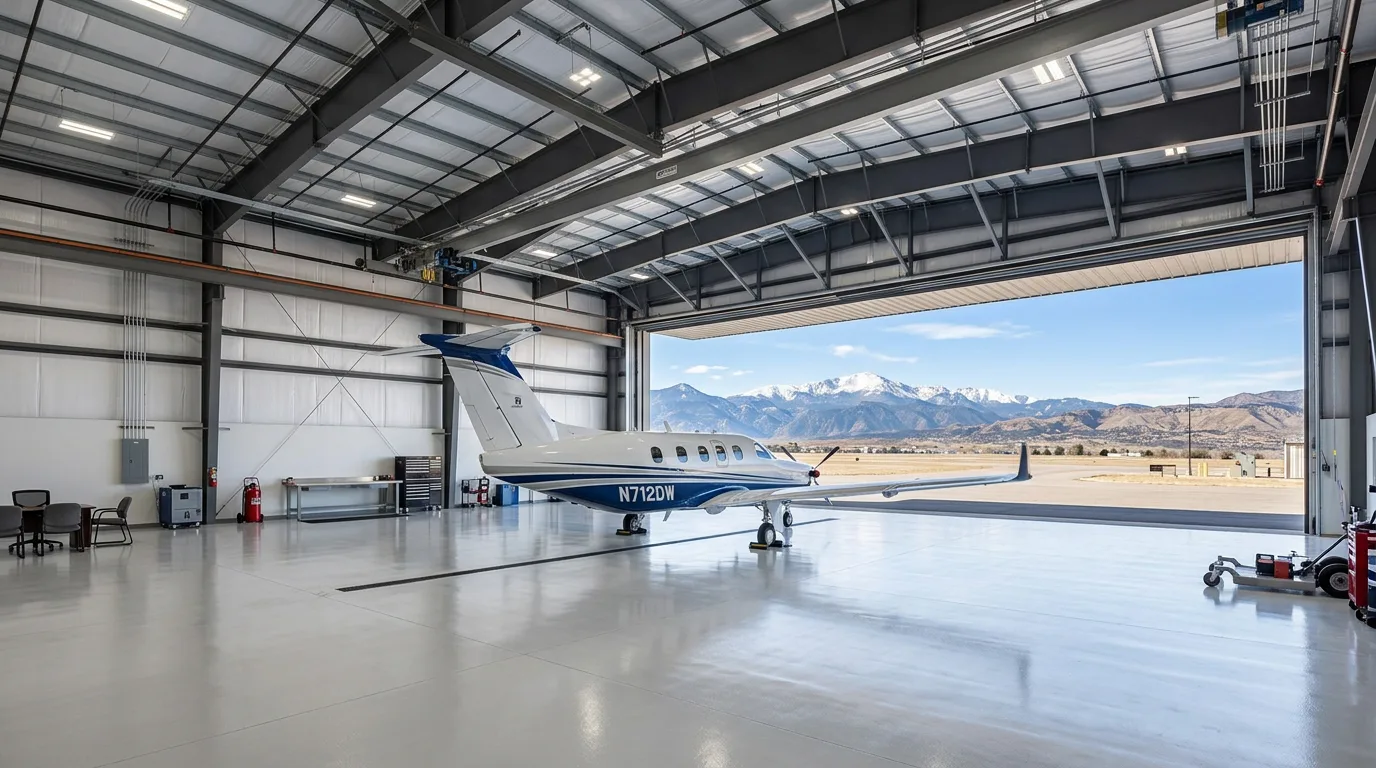
Aircraft hangars aren't garages with taller doors. Hangar floors handle concentrated point loads from jack stands, chemical exposure from AVGAS and Jet-A fuel, and — in Colorado — an aggressive freeze-thaw cycle at hangar door thresholds where snow, meltwater, and de-icing fluid track in daily. ProEpoxy Denver installs aviation-grade epoxy and polyaspartic systems engineered specifically for these demands, serving Centennial Airport, Rocky Mountain Metropolitan Airport, and Jeffco. See our aircraft hangar epoxy flooring service page for full system specs.
Why Aircraft Hangars Need Specialized Flooring
A typical aircraft resting on jacks concentrates its entire weight onto three or four small contact points — often less than a square inch each. Standard commercial epoxy, rated for distributed foot and light vehicle traffic, can crack or indent under this kind of point loading. Hangar floor systems use higher-build epoxy formulations with increased compressive strength, sometimes reinforced with quartz or aggregate broadcast for additional load distribution.
Point Load Rated
High-build epoxy systems handle concentrated loads from jack stands and tow bar contact points without indentation or cracking.
Fuel Resistant
AVGAS and Jet-A resistant topcoat formulations prevent softening, staining, and delamination from routine fuel handling and minor spills.
Chemical Tolerant
Hydraulic fluid, de-icing chemicals, and solvent-based cleaners are common in maintenance bays. Epoxy chemistry is matched to actual chemical exposure profile.
Threshold Durability
Hangar door tracks and apron transitions see the heaviest freeze-thaw cycling on the property. Reinforced edge detailing prevents premature failure at these high-stress zones.
Fuel & Chemical Resistance Requirements for Aviation Floors
Standard residential and light-commercial epoxy is not formulated to resist aviation fuel. AVGAS and Jet-A both contain aromatic solvents that will soften and eventually delaminate a generic epoxy system over repeated exposure. Aviation-grade epoxy uses a novolac or high cross-link-density resin system specifically resistant to these hydrocarbons.
Beyond fuel, hangar and maintenance floors regularly see hydraulic fluid from landing gear service, cleaning solvents, and de-icing fluid tracked in from the ramp. We formulate each hangar floor system based on the specific chemical exposure profile of the facility — a private single-aircraft hangar has different needs than an FBO maintenance bay handling turbine engine work.
Freeze-Thaw Ratings for Colorado Hangar Doors and Aprons
Denver-area airports sit at elevations between 5,800 and 6,900 feet, seeing more freeze-thaw cycling than the Denver metro core. Centennial Airport alone logs well over 150 annual freeze-thaw events. Hangar door tracks and the transition zone between the concrete apron and interior floor are the highest-stress areas — this is where meltwater, de-icing fluid, and temperature swings concentrate.
We detail these transition zones with flexible joint sealants and reinforced edge coating to prevent the cracking and spalling that plagues untreated hangar floors after just a few Colorado winters.
Denver-Area Airports and Airfields We Serve
- Centennial Airport (APA): One of the busiest general aviation airports in the country — private hangars, FBO facilities, and corporate flight departments.
- Rocky Mountain Metropolitan Airport (BJC): Broomfield-area GA airport, growing corporate and private hangar community.
- Jeffco / Colorado Air and Space Port: Jefferson County general aviation operations and specialty aerospace tenants.
- Private airstrips and ranch hangars: Front Range private airfields with individual hangar structures.
| Application | System Type | Price Range |
|---|---|---|
| Private single-aircraft hangar | High-build epoxy, fuel resistant | $6–$9 / sq ft |
| FBO / commercial hangar | Quartz-reinforced epoxy broadcast | $8–$12 / sq ft |
| Maintenance / MRO bay | Chemical-resistant urethane cement | $10–$14 / sq ft |
| Hangar apron transition detail | Flexible joint + reinforced edge | Quoted per linear ft |
Frequently Asked Questions
No — hangar floors must be AVGAS and Jet-A fuel resistant and rated for towing and jacking loads. Standard residential epoxy systems will soften, stain, or delaminate on contact with aviation fuel and hydraulic fluid, and are not engineered for concentrated point loads from jacks and tow bars.
Yes — both are primary service locations. Rocky Mountain Metro Airport also in our zone. We regularly coat private hangars, FBO facilities, and maintenance bays across all three Denver-area general aviation airports.
Yes — we coordinate with FBOs and operators to section the floor and maintain hangar operations. Aircraft are towed to an unaffected section while we prep and coat in phases, minimizing downtime for shared and commercial hangar spaces.