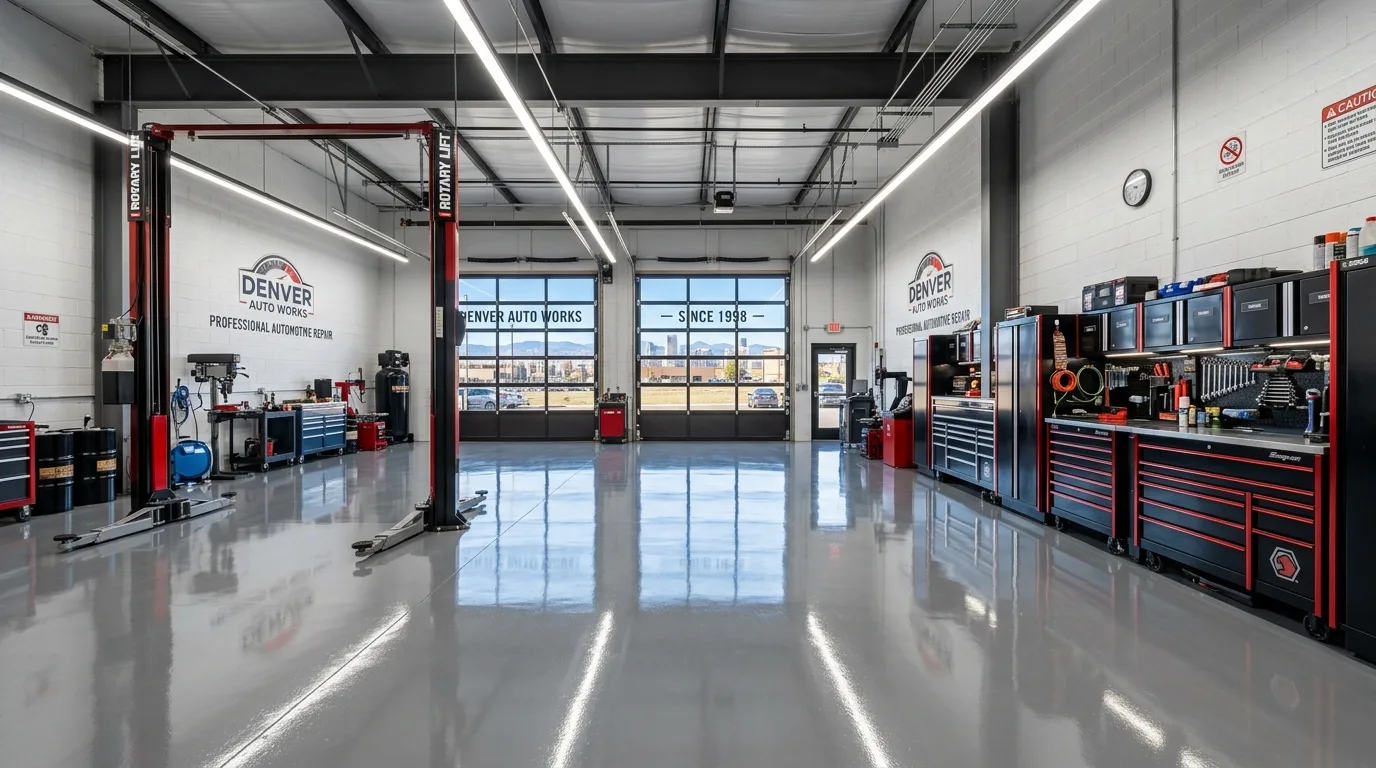
Why Automotive Floors Need a Different Spec Than Standard Garage Epoxy
Standard residential garage epoxy systems are designed for light vehicle storage and occasional foot traffic. Automotive shops and serious home garages have a different profile: concentrated point loads from jack stands and lift columns, chemical spills from engine oil, transmission fluid, brake fluid, and ethylene glycol coolant, and the notorious hot tire transfer problem in Colorado's warm summers.
Denver-specific considerations compound these demands:
- UV at 5,280 ft — Colorado receives 25% more UV than sea level. Standard epoxy topcoats amber and chalk within 2–3 years in Denver's sunlit bays and showrooms. Aliphatic polyaspartic topcoats are UV-stable and retain gloss indefinitely
- Freeze-thaw entry zone — vehicles enter carrying mag chloride, road salt, and ice melt in winter. The entry zone and drip zone see repeated chloride exposure that degrades standard epoxy faster than clean interior areas
- Hot tire transfer in summer — Colorado's 300+ sunny days and summer highs of 90–100°F heat tire compounds above 150°F, causing plasticizer transfer to standard epoxy topcoats. Parking marks appear and eventually become permanent stains
- Oil contamination in older shops — Denver's age-diverse housing stock means many garages have years of unprotected oil drip. Surface degreasing alone is insufficient — mechanical grinding is required
Polyaspartic topcoat standard: All ProEpoxy automotive installations use an aliphatic polyaspartic topcoat as standard — not standard epoxy. Polyaspartic resists hot tire plasticizer transfer, won't yellow at Denver's UV levels, and cures faster (walk-on in 4–6 hours vs. 12+ for standard topcoats). The cost premium over standard epoxy topcoat is typically 15–20% — worth it for any automotive application in Colorado.
Automotive Epoxy Applications We Install in Denver
Handling Oil-Contaminated Slabs in Denver Shops
Oil contamination is the most common reason automotive epoxy fails prematurely. When oil penetrates concrete, it acts as a bond-breaking layer — the epoxy adheres to the oil film rather than the concrete, and the coating delaminates within months. Box-store kits frequently fail in garages with oil history because acid etching alone cannot remove oil that has penetrated beyond the surface layer.
Our oil remediation protocol for Denver automotive floors:
- Step 1 — Commercial degreaser wash: industrial alkaline degreaser applied and allowed to dwell, then pressure washed. Repeated 2–3 times in heavily contaminated areas
- Step 2 — Diamond grinding: CSP-2 or CSP-3 diamond grinding removes the top 1–3mm of concrete surface where oil has penetrated. This is non-negotiable for automotive applications — acid etching does not achieve equivalent removal
- Step 3 — Contamination test: water droplet absorption test on ground surface confirms clean concrete. Water that beads indicates residual contamination requiring additional grinding
- Step 4 — Oil-tolerant primer (if needed): for deeply contaminated areas where grinding reaches acceptable contamination limits but not zero, an oil-tolerant epoxy primer bonds over mildly contaminated substrates
Denver Automotive Epoxy Installation
Assessment: Oil, Cracks, Lift Anchor Points
Full inspection including tap-testing for hollow spots, moisture reading, oil contamination mapping, lift anchor point inspection, and crack classification. We document condition with photos and provide a scope of work before pricing.
Degreasing + CSP-3 Diamond Grinding
Commercial degreaser wash followed by diamond grinding to CSP-3 profile — heavier than residential applications to penetrate oil contamination. Lift bay areas ground extra passes around anchor zones. Cracks and spalls repaired with polyurea filler and epoxy mortar before coating.
100% Solids Epoxy Base Coat
High-build 100% solids epoxy (not water-based) applied at 10–12 mils thickness. Automotive applications get a heavier base coat than standard residential. Decorative vinyl flake broadcast into wet base coat where specified — full broadcast for maximum coverage and texture.
Aliphatic Polyaspartic Topcoat (2 coats)
Two coats of UV-stable aliphatic polyaspartic topcoat — non-yellowing at Denver's UV levels, hot tire resistant, chemical resistant. Walk-on in 4–6 hours. Full vehicle drive-on in 24 hours. No spiked shoes or furniture dollies for 72 hours during full cure.
Pricing for Denver Automotive Epoxy
| Application | System | Typical Range |
|---|---|---|
| Residential garage (clean slab) | Epoxy + polyaspartic | $4–$6/sqft |
| Residential garage (oil history) | Grind + degreaser + epoxy + poly | $5–$7/sqft |
| Professional auto shop | Heavy-build commercial system | $6–$9/sqft |
| Showroom / collector storage | Metallic or high-gloss solid color | $7–$11/sqft |
| Fleet / heavy commercial | Polyurea or full polyaspartic | $8–$14/sqft |
Frequently Asked Questions
Standard epoxy topcoats can show tire marks (plasticizer transfer) from hot tires, especially in Colorado's warm summers when asphalt heats tire compounds above 150°F. The solution is an aliphatic polyaspartic topcoat — far more resistant to plasticizer transfer than epoxy topcoats. We use polyaspartic on all automotive applications as standard. No extra charge.
Epoxy itself is not the load-bearing element — the concrete slab is. A properly installed epoxy system has no effect on load-bearing capacity. What matters is that the slab meets the lift manufacturer's minimum requirements (typically 4" minimum, 3,500 psi). We inspect slab condition around lift anchor points and repair spalls or cracks before coating to ensure clean anchor installation.
Oil contamination is one of the most common adhesion failure points. We use commercial degreaser wash (2–3 cycles) followed by diamond grinding to remove the top surface layer where oil has penetrated. Deep contamination may require repeated degreasing cycles. If contamination is beyond mechanical removal range, we apply an oil-tolerant epoxy primer specifically formulated to bond over mildly contaminated substrates before the decorative system.
See garage epoxy service page for specs, or explore polyaspartic coatings and epoxy floor repair.