How Denver's Climate Damages Epoxy Floors
Denver's 155+ freeze-thaw cycles per year make floor coating damage inevitable without the right system — and they accelerate existing damage exponentially. When water enters a crack and freezes, it expands with roughly 2,000 psi of force. In concrete, that force widens and deepens cracks with each cycle. In epoxy coatings, it lifts the coating from the substrate, creating delamination that spreads outward from the original defect.
Three primary failure modes appear in Denver floors:
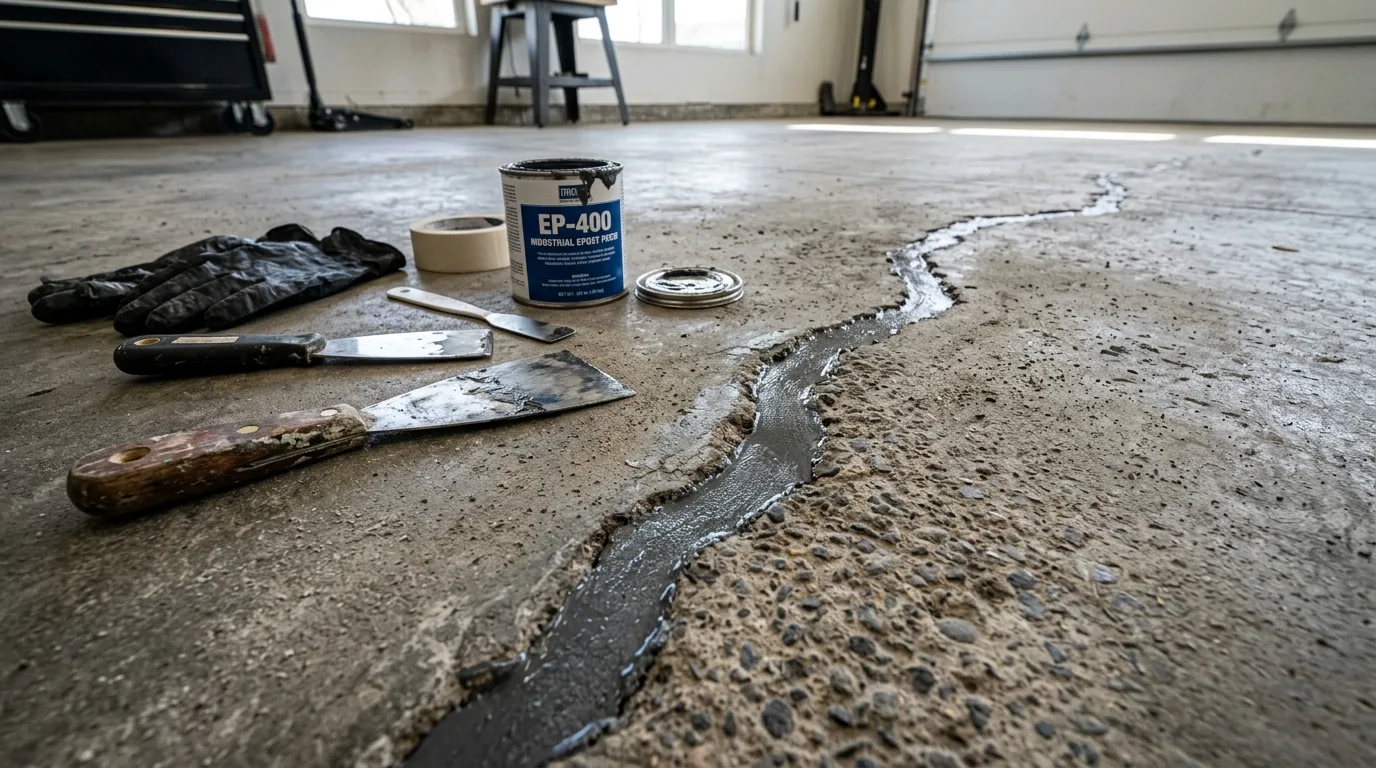
- Hairline and structural cracks — concrete shrinkage cracks are normal and manageable if sealed early. Untreated cracks admit water, which freezes and widens them through the slab thickness
- Spalling — surface pop-outs and pitting from mag chloride and road salt carried in on tires. Colorado's preferred deicer penetrates concrete and reacts with calcium hydroxide, causing surface layer disintegration
- Delamination — coating bubbles and lifts, most commonly from DIY epoxy applied without mechanical grinding, or from moisture vapor trapped beneath the coating
The escalation pattern: A hairline crack costs $50–$200 to fill and seal. Left for two Denver winters, the same crack becomes a structural crack requiring $300–$800 in repair. After five winters without repair, it becomes spalling that requires grinding, patching, and recoating — $2,000+. Early repair is always cheaper than deferred repair.
Types of Epoxy Floor Damage We Repair
Our Repair Process
Damage Assessment & Root Cause Identification
We inspect every square foot for crack width, spall depth, delamination extent, and moisture vapor emission. Tap-testing identifies hollow areas under intact-looking coating — a ringing sound means the coating has separated from the slab even where it looks solid. Moisture test placed where needed. Root cause documented before any repair begins.
Mechanical Removal of Failed Material
Delaminated coating ground out with angle grinder or shot blaster — no exceptions. Spalls chiseled or ground to clean, sound concrete at the edges. Crack routing if needed for structural cracks to create a uniform channel for filler. All dust and debris vacuumed before repair products applied.
Crack Injection, Spall Patching, Moisture Treatment
Low-viscosity epoxy injected into hairline cracks under slight pressure. Flexible polyurea filler packed into structural cracks and control joints. Epoxy mortar troweled into spalls and ground flush at 2–4 hr cure. Moisture-mitigating primer applied over any areas with elevated vapor emission before recoating.
Recoat: CSP-2 Grind + Epoxy + Polyaspartic Topcoat
Repaired areas and surrounding slab abraded to CSP-2 profile for adhesion. Full epoxy base coat applied, matching existing color or new finish if full recoat. Aliphatic polyaspartic topcoat applied — UV-stable at 5,280 ft, freeze-thaw rated, 6–8 hr walk-on. Seamless finish integrates repaired areas.
Repair vs. Full Replacement — Denver Cost Guide
| Damage Type | Repair Cost | Full Replacement |
|---|---|---|
| Hairline cracks only | $200–$600 | $1,200–$2,400 (500 sqft) |
| Structural cracks + spalls | $500–$1,500 | $2,000–$4,000 |
| Partial delamination (<30%) | $800–$2,000 | $2,000–$4,000 |
| Widespread delamination (>50%) | $1,500–$3,000 | $2,000–$4,000 |
| Full recoat after repair | $2–$4/sqft add-on | $4–$8/sqft full system |
When delamination exceeds 50–60% of the floor area, full removal and recoat often costs less than targeted repair plus a full topcoat. We provide both options with firm pricing before work begins.
Frequently Asked Questions
Yes, with proper prep. Delaminated or bubbled areas must be ground out completely — you cannot recoat over failed epoxy and expect adhesion. Solid, well-bonded existing epoxy can be scuff-abraded and recoated. We test adhesion with a cross-cut or pull-off test before deciding. In Denver, delamination is often moisture-related, so we address the root cause before recoating.
Crack injection and spall patching cure in 2–4 hours before the next coat is applied. A full recoat after repairs requires 8–12 hours walk-on time. Most repair-and-recoat projects complete in one day, with return to full use in 24 hours. Larger delamination repairs may need 2 days.
Most common: moisture vapor trapped beneath the coating from inadequate surface prep, or road salt and mag chloride carried in on tires that penetrated micro-cracks. Denver's 155+ freeze-thaw cycles per year also stress the bond line as the slab expands and contracts. DIY epoxy kits applied without mechanical grinding are the leading source of early delamination — box-store kits use acid etching, which is insufficient for long-term adhesion.
See epoxy floor repair service page for full specs, or explore garage epoxy and parking garage systems.