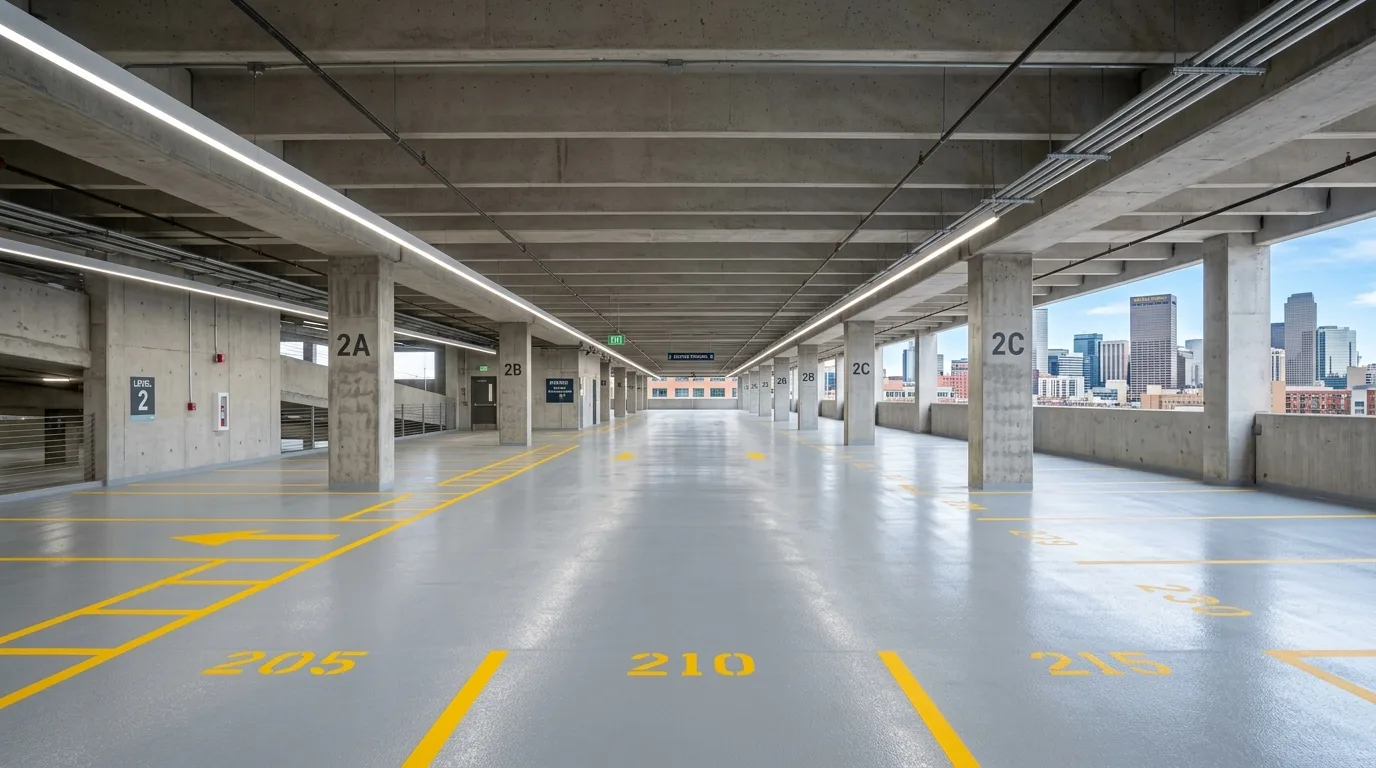
What Makes Parking Garage Coatings Different
Parking garage floors are not warehouse floors with cars on them. They are exposed structural concrete decks that face a combination of stresses that no other floor type experiences simultaneously:
- Dynamic vehicular loading — repeated wheel loads from vehicles, especially at turning radii where lateral stress concentrates
- Thermal cycling through deck joints — open-deck and top-deck levels experience full exterior temperature swings, creating movement at expansion joints that coatings must accommodate
- Mag chloride and road salt intrusion — vehicles bring deicing chemicals into the structure on their tires; these chlorides penetrate uncoated concrete and corrode rebar, causing structural spalling
- Hydrostatic pressure on lower decks — water infiltrates from levels above and must be managed with waterproofing membranes that direct drainage rather than trap moisture
- Carbon dioxide carbonation — vehicle exhaust contributes to concrete carbonation, which lowers the pH that protects embedded steel
Standard epoxy coatings address abrasion and chemical spills. Parking garage traffic deck systems must address all of the above simultaneously — which is why parking deck coating is a specialized subfield of the floor coating industry, not simply a variant of commercial epoxy.
Colorado deicer reality: Colorado DOT and most Denver metro municipalities use magnesium chloride as their primary deicer because it works at lower temperatures than sodium chloride. Mag chloride is highly effective on roads but aggressive on concrete structures — it penetrates faster than road salt and has higher chloride concentration. Denver parking garages that aren't protected by a proper waterproofing membrane see accelerated rebar corrosion and spalling within 10–15 years.
Waterproofing Membranes vs Standard Epoxy
Road Salt and Mag Chloride Resistance
Concrete is naturally alkaline (pH 12–13), and this high pH is what protects embedded steel rebar from corrosion. Chlorides from mag chloride and road salt lower the pH at the rebar surface, breaking down the passive protection layer and initiating corrosion. Once corrosion begins, the expanding iron oxide (rust) creates internal pressure that causes concrete to crack and spall from the surface — the characteristic "pothole" damage seen on aging Denver parking structures.
Traffic deck membranes prevent chloride intrusion by creating a chemical barrier between the concrete surface and vehicle-deposited deicers. The membrane must be continuous and maintained — cracks or worn areas allow concentrated chloride exposure at exactly the points where the concrete is most vulnerable.
Properly applied traffic deck systems in Denver typically provide 10–15 years of service before recoating is required. This compares favorably to uncoated decks that often require concrete repair and structural intervention within the same timeframe.
Denver Parking Structures We Serve
Commercial Office & Retail Structures
LoDo, Cherry Creek, and downtown Denver commercial parking structures. We work around business hours — night and weekend shifts minimize disruption to tenants and shoppers. Level-by-level phasing allows partial operation during the project.
Residential Condo & HOA Garages
Condominium and apartment parking structures in Denver's growing urban core. HOA projects require careful communication with residents about temporary parking disruption. We provide project timelines for HOA board approval and resident notification.
Municipal & Government Structures
City of Denver, RTD transit center parking, and DIA ground transportation facilities. Public projects require certified insurance, bonding, and compliance with prevailing wage requirements where applicable. We are licensed for Colorado public works contracts.
Hospital & University Campus Parking
Anschutz Medical Campus, UCHealth, and Denver's university parking structures operate continuous operations that require 24/7 phased access. We design project phases around operational constraints — no complete facility closure required for most structures.
Pricing for Denver Parking Garage Systems
| System | Application | Typical Range |
|---|---|---|
| Epoxy broadcast — interior lower decks | Abrasion + chemical resistance | $5–$8/sqft |
| Polyurethane traffic membrane | Waterproofing, top/exposed decks | $8–$12/sqft |
| Polyurea traffic membrane (heavy duty) | High-traffic, long-term protection | $10–$14/sqft |
| Joint sealant (expansion joints) | Flexible chloride barrier | $15–$25/lft |
| Line marking (included in full system) | Stall stripes, directional, ADA | Included |
Parking structure projects are quoted per level based on deck area, condition, and system specification. We provide a phasing plan with the quote showing how the project will be executed while maintaining partial facility access.
Frequently Asked Questions
Yes — parking garage traffic decks require waterproofing membranes and deicer-resistant systems specifically for Colorado winters. Warehouse floors primarily need abrasion and chemical resistance to forklift fluids. Parking decks face vehicular wheel loads, cyclic freeze-thaw through deck joints, and concentrated mag chloride and road salt from tires — a different performance specification entirely.
Yes — line marking is included as part of our full traffic deck systems. We stripe after the final topcoat cures, using thermoplastic or epoxy-based traffic paint rated for vehicular abrasion. If you only need restriping without a full recoat, we offer that as a standalone service.
Yes — we bid Denver city, RTD, and Denver International Airport parking projects. Municipal bids require insurance certificates, certified payroll in some cases, and Colorado contractor licensing. We are licensed, bonded, and carry the insurance levels required for city and state projects. Contact us for a pre-bid meeting on public projects.
See the parking garage service page or explore commercial epoxy and polyurea coating options.