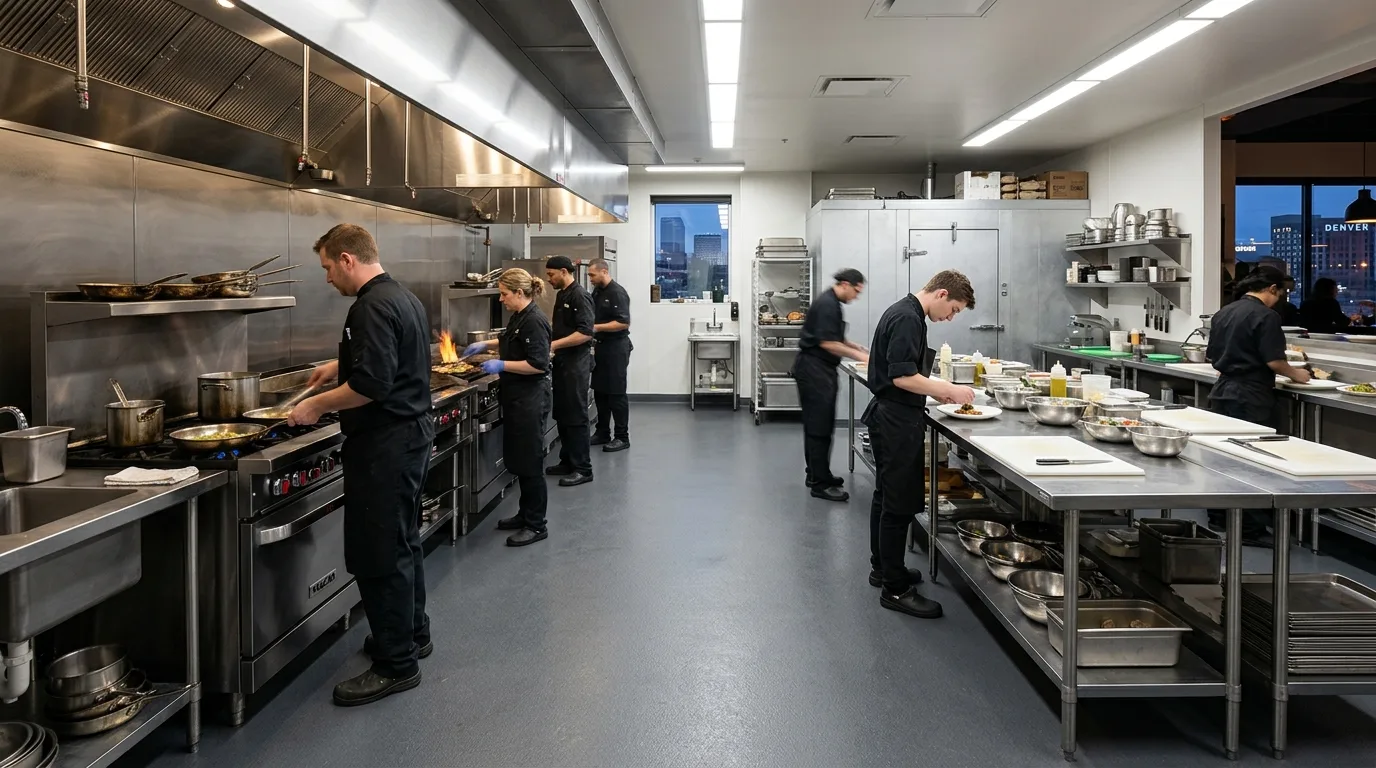
Why Denver Restaurants Need Specialized Epoxy
A restaurant floor takes abuse that would destroy most commercial coatings within a year: daily hot water and steam, repeated chemical sanitizer applications, fryer oil spills, heavy equipment rolling on hard casters, and foot traffic at densities that rival airports. Standard commercial epoxy — the kind installed in warehouses or retail spaces — is not formulated to handle the combination of thermal shock, chemical cycling, and slip risk that defines a working commercial kitchen.
Restaurant-grade epoxy systems are a distinct product category. They require:
- Non-slip aggregate broadcast — aluminum oxide or silica sand broadcast into the topcoat creates a gripped surface that maintains safe DCOF ratings even with grease on the floor
- Thermal shock resistance — hot water from steam cleaning hitting a cold floor creates rapid expansion/contraction. Systems must use flexible urethane or polyaspartic chemistry rather than rigid epoxy alone
- Chemical compatibility — quaternary ammonium sanitizers, chlorinated degreasers, and acidic descalers used daily in commercial kitchens degrade inferior topcoats within months
- Seamless cove base — the wall-to-floor joint sealed with integral cove base eliminates the gap where organic material accumulates under grout lines, a common health code failure point
Denver's restaurant scene — from RiNo craft breweries to Cherry Creek fine dining to Capitol Hill neighborhood spots — has increasingly specified seamless epoxy as the standard kitchen floor, not the exception. Health code requirements from the Denver Department of Public Health & Environment (DDPHE) mandate non-porous, washable, non-absorbent surfaces in all food prep areas, and seamless epoxy satisfies all three requirements in one installation.
NSF Compliance and Denver Health Code
NSF/ANSI 51 is the food equipment safety standard most commonly referenced when specifying commercial kitchen floors. While the standard itself applies to food equipment, the underlying requirements — non-porous, non-toxic, cleanable, corrosion-resistant — directly translate to flooring specification for facilities subject to DDPHE inspection.
Our restaurant epoxy systems are installed using 100% solids formulations with no plasticizers that could leach into food contact areas. The seamless finish meets DDPHE requirements and we provide a written material specification sheet for your health department file. For facilities that receive FDA oversight (food manufacturing, USDA-inspected processors), we can provide systems with full chemical resistance documentation.
Denver altitude advantage: At 5,280 ft, polyaspartic topcoats cure 20–25% faster than at sea level due to lower ambient vapor pressure. Walk-ready in 6–8 hours rather than 10–12. This matters for restaurant installs: a Friday evening application is walk-ready by early Saturday morning, with full chemical resistance by Sunday brunch service — no need to close for the weekend.
Restaurant Epoxy Installation Process
Pre-Install Assessment & Drainage Review
Site visit to map existing floor drains, slope direction, grease trap locations, and equipment footprints. Identifies any existing coating, concrete damage, or moisture issues. We schedule install around your service calendar — most Denver restaurant installs happen Friday night through Saturday.
CSP-3 Diamond Grinding & Drain Prep
Commercial Shotblast Profile 3 (CSP-3) diamond grinding opens the concrete pores for maximum adhesion and removes existing coatings, grease contamination, or damaged surface concrete. Drain surrounds are taped and protected; cove base areas are cut and cleaned.
Epoxy Base + Broadcast Aggregate
100% solids epoxy base coat applied, followed immediately by broadcast of aluminum oxide or silica aggregate to refusal (full saturation). This creates the mechanical grip profile that keeps DCOF above 0.42 wet even under greasy conditions — the layer that prevents slip-and-fall incidents.
Polyaspartic Topcoat & Cove Base Seal
Aliphatic polyaspartic topcoat locks in the aggregate and provides chemical resistance to all standard kitchen sanitizers and degreasers. Integral cove base installed simultaneously, sealing wall-to-floor junction. Full system cures in 24 hours at Denver's altitude — faster than manufacturer data sheets assume.
Pricing by Restaurant Zone
| Zone | System | Typical Range |
|---|---|---|
| Kitchen / Prep Areas | Non-slip broadcast epoxy + polyaspartic | $7–$10/sqft |
| Bar & Service Wells | Chemical-resistant epoxy + cove base | $6–$9/sqft |
| Dining Room / Front of House | Decorative flake or metallic system | $5–$8/sqft |
| Brewery / Production Floor | High-build urethane cement or epoxy | $8–$14/sqft |
| Cove Base (all areas) | Integral epoxy cove base | $8–$14/lft |
Most Denver restaurant kitchen installs (400–800 sqft) run $3,500–$8,000 total including surface prep, materials, and labor. Dining room decorative systems are typically lower cost per square foot. Full restaurant floor packages (kitchen + dining + bar) are priced together with a single mobilization fee.
Denver Restaurant Districts We Serve
RiNo (River North) — Denver's Brewery & Restaurant Row
High concentration of craft breweries, food halls, and ghost kitchens. We have installed brewery production floors, taproom bar areas, and shared kitchen facilities throughout the RiNo corridor. Familiar with the neighborhood's older industrial building stock and concrete conditions.
Cherry Creek & Glendale
Upscale dining, fast-casual, and hotel food service. Cherry Creek customers often want decorative dining room systems matched with practical kitchen systems — unified aesthetic with different performance specs by zone.
Capitol Hill, Colfax & Highland
Neighborhood restaurants, bars, and coffee roasters in older buildings with variable concrete quality. Our pre-install assessment identifies slab condition issues before they become cost surprises. Moisture mitigation primers available for problematic slabs.
Suburban Restaurant Corridors (Aurora, Lakewood, Westminster)
Chain restaurant retrofits, quick-service kitchen upgrades, and food court operators in Denver's suburban commercial corridors. Standard service zone — no travel surcharge within the metro.
Frequently Asked Questions
Yes — our aliphatic polyaspartic topcoat reaches full chemical resistance in 24 hours at Denver's altitude. We can install Friday night after close and have the kitchen back in service by Saturday morning prep, with full chemical resistance by Sunday brunch service. Most Denver restaurant installs follow this Friday-night schedule.
Our seamless epoxy systems meet Denver Department of Public Health & Environment (DDPHE) requirements for commercial food preparation surfaces: non-porous, washable, light-colored, and non-absorbent. We provide a written material specification sheet for your inspection file upon install completion.
Colorado food service regulations require a minimum DCOF of 0.42 wet for commercial kitchen floors. Our standard restaurant epoxy broadcast system achieves 0.55–0.65 DCOF wet — well above the threshold even with grease present, which is the real-world condition that matters for worker safety and liability.
See our commercial epoxy service page for full specs, or explore Aurora and Lakewood service areas for suburban restaurant locations.