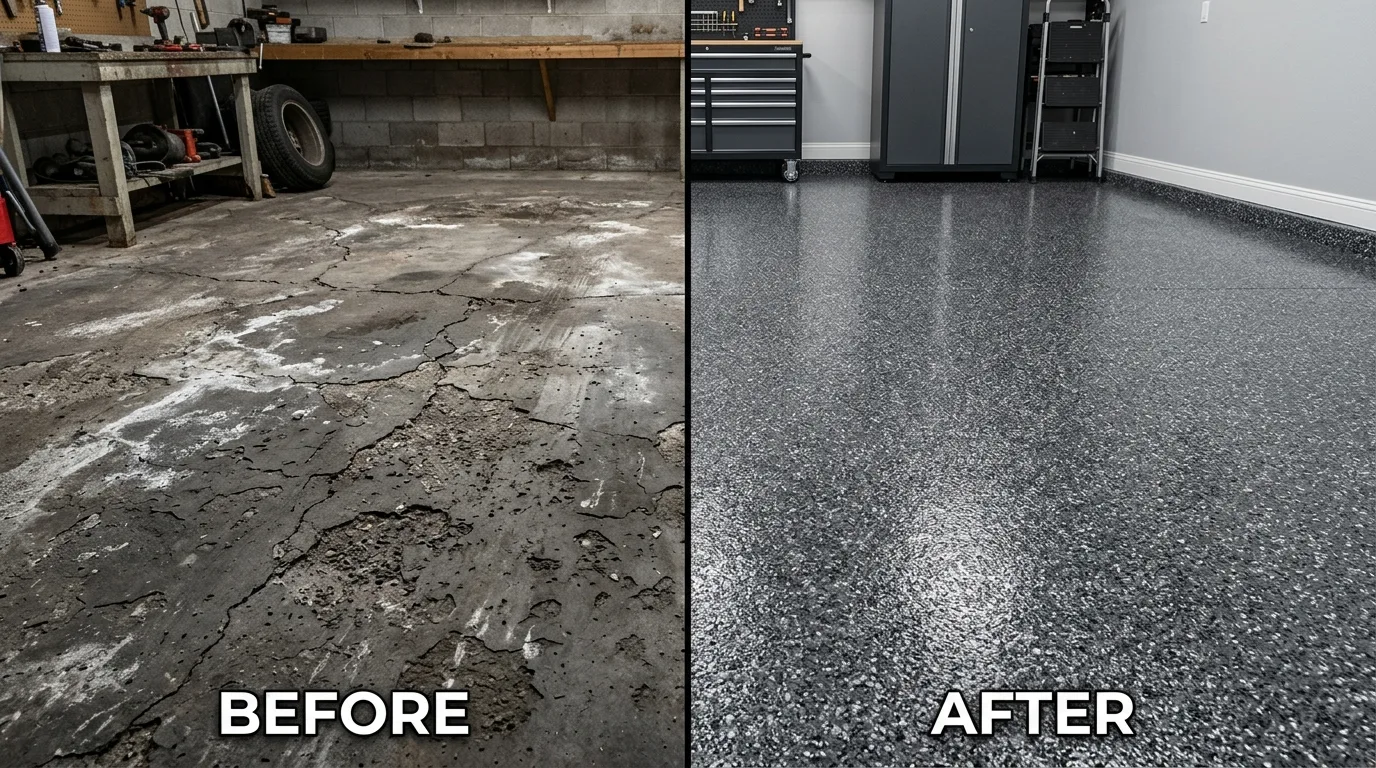
Colorado garage floors take a beating most homeowners underestimate — freeze-thaw cycling, road salt, oil, and daily wear compound quietly until the concrete is visibly failing. Here are the seven signs that mean it's time to stop patching and get a proper epoxy or polyaspartic system installed. For deeper background, see our Signs Your Garage Needs Epoxy resource page.
1Concrete Dust Every Time You Sweep
If your broom or shop vac fills with fine gray dust after every sweep, your slab is actively shedding its surface — a process called "dusting." Unsealed concrete is porous and slowly wears away under foot and tire traffic. Epoxy seals that porous surface permanently, ending the dust cycle for good.
2Freeze-Thaw Cracks and Spalling
Colorado's 150+ annual freeze-thaw cycles are relentless on exposed concrete. Water infiltrates surface pores, freezes, and expands — spalling off small chips or opening hairline cracks that widen with each winter. Left unaddressed, this progresses from cosmetic to structural.
3Road Salt and Mag Chloride Stains That Won't Budge
White or gray staining that survives scrubbing means salt and magnesium chloride have penetrated below the surface. Surface cleaning can't remove embedded mineral deposits — they require diamond grinding to fully extract before any coating can properly bond.
4Old Coating That's Peeling or Flaking
A DIY epoxy kit or improperly prepped previous coating that's now peeling is often worse than no coating at all — it traps moisture and creates an uneven bonding surface. Full removal back to bare concrete, followed by proper diamond-ground prep, is the only fix.
5Moisture Seeping Up From Below
Dark damp patches, a white powdery residue (efflorescence), or a persistent musty smell all point to moisture vapor moving up through the slab. This needs assessment — typically a calcium chloride or relative humidity test — before any coating system is specified, since the wrong system over a moisture-active slab will fail.
6The Rough Surface Traps Dirt and Road Debris
A textured, porous concrete surface holds onto dirt, gravel, and road debris that a sealed epoxy floor simply releases with a damp mop. If your garage always looks dirty no matter how often you sweep, the surface itself — not your cleaning habits — is the problem.
7It Looks Embarrassing — Your Home Deserves Better
Sometimes the sign isn't damage — it's just that a stained, dated concrete floor no longer matches the rest of a well-kept home. A clean, glossy epoxy floor is one of the highest-visibility, lowest-disruption upgrades a Denver homeowner can make, often completed in a single weekend.
Frequently Asked Questions
Yes — water infiltrates pores, freezes, expands, and spalls concrete over time. Epoxy seals the surface and stops the cycle before it can progress into structural surface damage.
Diamond grinding removes embedded salt residue. Surface cleaning alone is not sufficient prep — salt and mineral deposits penetrate below the visible surface and will compromise coating adhesion if not mechanically removed.
Diamond grinding removes embedded oil. We degrease and profile to CSP-2/3 before any coating — a step many lower-cost contractors skip, leading to early coating failure over oil-contaminated areas.