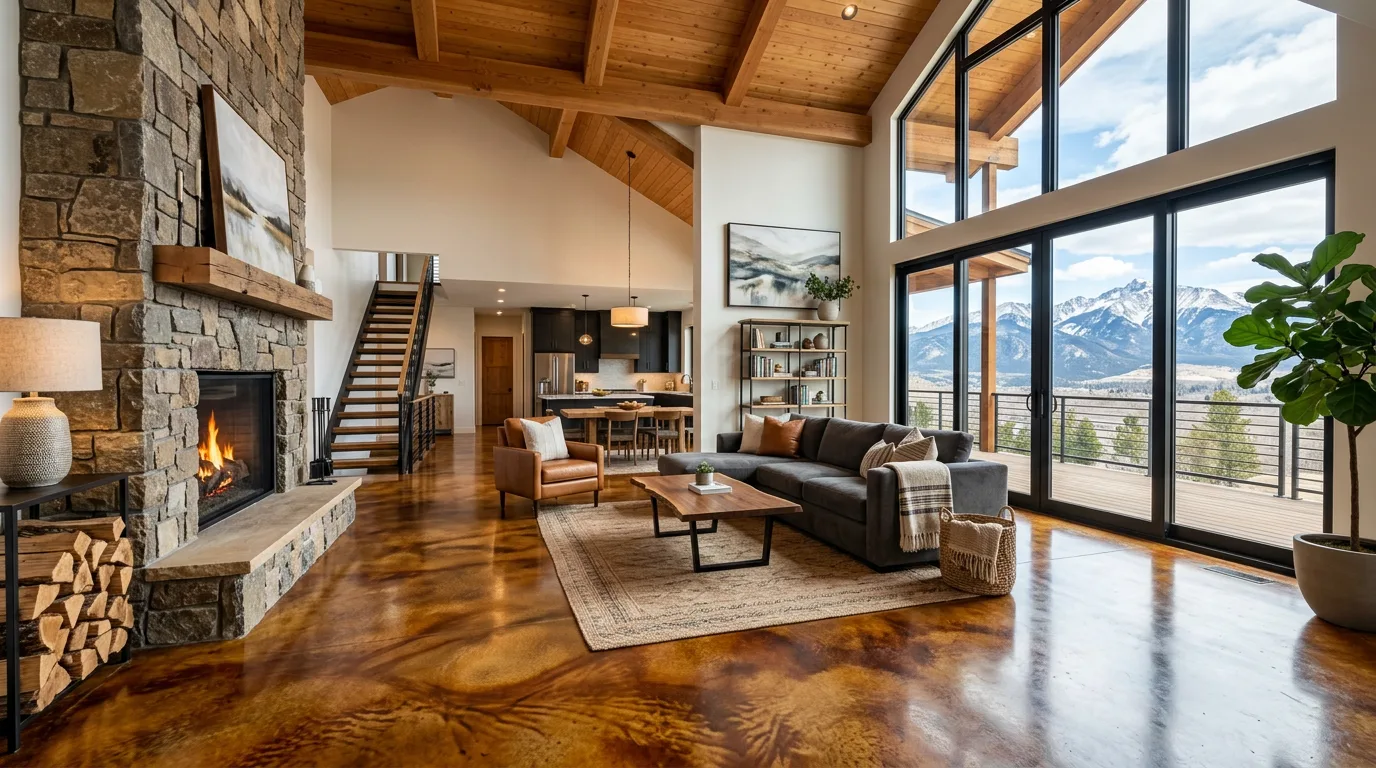
Stained concrete is one of the most visually distinctive floor finishes available — and one of the most misunderstood. Unlike paint or epoxy, concrete stain doesn't sit on top of the surface. Acid stain chemically reacts with the concrete itself, producing variegated earth-tone color that becomes part of the slab. The result: a finish that can't peel, chip, or delaminate, and that develops character with age rather than degrading. See our stained concrete floors service page for color and application options.
Acid Stain vs Water-Based Concrete Stain
Two fundamentally different products share the "concrete stain" label. Understanding the difference determines which is right for your Denver project.
| Property | Acid Stain | Water-Based Stain |
|---|---|---|
| Chemistry | Reacts with concrete minerals | Penetrates as pigment suspension |
| Color permanence | Permanent — cannot be removed | Long-lasting — may fade over decades |
| Color palette | Earth tones: amber, brown, terra cotta, blue-green | Full spectrum including pastels and vivid colors |
| Finish character | Variegated, marbled, organic | More uniform, predictable coverage |
| Application skill | High — reaction is irreversible | Moderate — more forgiving |
| Best for Denver | Mountain-modern, Southwestern aesthetics | Contemporary, colorful, retail/commercial |
For most Denver residential projects — Highlands bungalows, LoHi condos, mountain-modern homes in Stapleton and Sunnyside — acid stain's organic earth-tone palette aligns naturally with Colorado's design vernacular. Water-based stain gets the call when a client needs a specific color that acid chemistry can't produce.
Popular Colors for Denver Homes
Acid stain colors are influenced by the concrete mix design and existing mineral content — no two slabs stain identically. That variability is the point. Denver's Front Range slabs typically produce rich amber, burnt sienna, and blue-green undertones from the iron compounds and lime in local aggregate mixes.
Amber & Honey
Most popular acid stain in Denver. Warm bronze-to-amber range with lighter veining. Pairs with natural wood, exposed brick, and mountain-modern millwork.
Terra Cotta & Sienna
Rich red-brown with earthy variation. Common in Southwestern and adobe-inspired Denver homes. Strong contrast with light walls and ceilings.
Patina Blue-Green
Oxidized copper effect. Unique to acid chemistry — water-based can't replicate the mottled teal-grey that high-copper acid stains produce on Denver slabs.
Dark Espresso
Near-black with subtle brown undertones. Strong contemporary look. Requires aggressive prep to achieve consistent dark saturation — surface must be free of any residue.
Where Stained Concrete Works Best in Colorado
Stained concrete performs best on sound, lightly profiled slabs with no previous coating or sealer that would block stain penetration. Denver's dry climate means most interior slabs are good candidates — less moisture vapor than coastal markets, better stain adhesion, and shorter dry times between coats.
- Living rooms and open-plan areas: Earth-tone stain complements the mountain-modern aesthetic dominant in Denver's residential market.
- Basement floors: Concrete stain is chemically bonded — no delamination risk if minor moisture migration occurs through the slab. Pair with a penetrating silane sealer for best vapor management.
- Patios and covered outdoor areas: UV-stable water-based stain (not acid) for outdoor use. Acid stain colors can shift under prolonged UV exposure without a UV-blocking sealer.
- Restaurant and bar floors: Mottled acid stain in earth tones is increasingly common in Denver's RiNo and LoHi dining scene — looks intentional, hides wear patterns well.
- Retail and studio spaces: Water-based stain in brand colors or custom hues for commercial identity.
Maintenance of Stained Concrete in Denver's Dry Climate
Stained concrete maintenance in Denver is simpler than in high-humidity markets — the sealer layer doesn't have to work as hard against moisture vapor. The main threat in Colorado is UV degradation of the sealer, not moisture.
- Daily: Damp mop with pH-neutral cleaner. Avoid acidic cleaners (vinegar, citrus) — they etch both the stain and sealer over time.
- Annual: Inspect sealer integrity. Dull, chalky, or water-absorbing spots indicate sealer wear — buff with a floor machine and apply a maintenance coat before full reapplication is needed.
- Every 3–5 years: Full reseal with UV-stable penetrating sealer. At 5,280 ft, Colorado's UV index degrades standard acrylic sealers faster than at sea level — specify aliphatic or silane-based products for Denver applications.
Frequently Asked Questions
Yes — acid stain chemically reacts with the calcium hydroxide in concrete and cannot be removed. The color is permanent and often deepens in richness over time as the chemical bond matures. This is why surface preparation is critical: any contamination (oil, paint, sealer) will block the reaction and create bare spots.
Slightly — lower air pressure at 5,280 ft can speed the chemical reaction time. We adjust dwell time for Colorado conditions to prevent over-reaction, which can cause uneven coloration or surface hazing. Our crews are calibrated for Denver's altitude and low-humidity environment.
Yes — reseal every 3–5 years with a UV-stable penetrating sealer to protect from Colorado's intense UV at altitude. At 5,280 ft, UV intensity runs 25% above sea level, which can fade or yellow standard acrylic sealers faster than at lower elevations. We specify aliphatic or silane-based sealers for Denver applications.