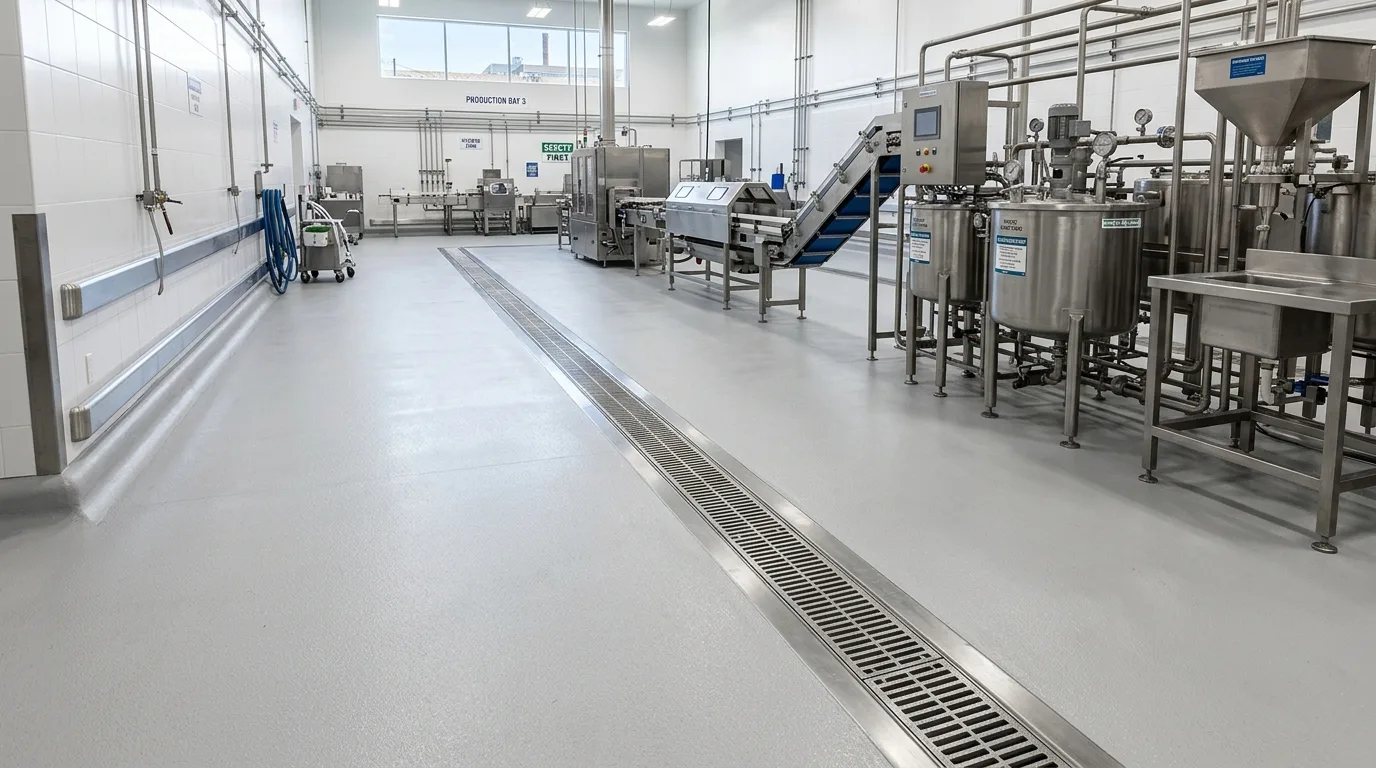
Some floors ask more of a coating system than standard epoxy can deliver. Commercial kitchens, food processing plants, and heavy industrial facilities combine thermal cycling, chemical exposure, and impact loads that push epoxy past its limits. Urethane cement fills that gap — a cement-based matrix that's more rigid than epoxy and dramatically more resistant to thermal shock, making it the standard specification for Denver's food-service and industrial sector. Visit our urethane cement flooring service page for system specs.
What Makes Urethane Cement Different From Epoxy
Epoxy and urethane cement are chemically distinct systems. Epoxy is a resin-based coating that sits on top of the substrate. Urethane cement is a trowel-applied cementitious system reinforced with polyurethane resin — thicker, more rigid, and formulated to handle the temperature extremes and heavy mechanical loads that epoxy alone can't tolerate long-term.
Thermal Cycling
Handles rapid temperature swings from steam cleaning, hot equipment, and freezer-to-kitchen transitions without cracking or delaminating.
Impact Resistance
Cementitious matrix withstands dropped equipment, pallet jacks, and heavy foot traffic better than resin-only epoxy systems.
Chemical Resistance
Resists animal fats, acids, sugars, and cleaning chemicals common in food processing — without the softening some epoxy systems show under sustained exposure.
Seamless & Coved
Coved base eliminates the wall-floor junction where bacteria and debris typically collect — a health department requirement for food-contact areas.
Thermal Shock Resistance for Commercial Kitchen Environments
Commercial kitchens routinely subject floors to abrupt temperature swings: a steam cleaning cycle can hit 180°F+ before the surface returns to room temperature minutes later; hot fat and grease from cooking equipment does the same at localized spill points. Standard epoxy expands and contracts with these swings differently than the concrete substrate beneath it — repeated cycling eventually causes cracking or bond failure at the interface.
Urethane cement's thermal expansion coefficient is closely matched to concrete, and its cementitious base handles rapid heat exposure without the softening or bond stress that affects resin-only coatings. This is why nearly every commercial kitchen renovation and food processing build-out in Denver specifies urethane cement over standard epoxy for direct food-contact floor areas.
Freeze-Thaw Performance in Colorado Industrial Facilities
Beyond thermal shock from kitchen operations, Denver's industrial and food-processing facilities also contend with genuine freeze-thaw cycling — loading dock areas, walk-in freezer transitions, and exterior-adjacent processing zones see the same 150+ annual freeze-thaw events that affect any exposed Colorado concrete. Urethane cement's dense, low-permeability matrix resists moisture intrusion far better than standard epoxy, reducing the freeze-thaw spalling risk at these vulnerable transition zones.
Cost of Urethane Cement vs Epoxy in Denver
Urethane cement carries a higher upfront cost than epoxy, reflecting both material cost and labor-intensive trowel application — but for facilities with genuine thermal, chemical, or impact demands, the extended service life offsets the premium.
| System | Best For | Price Range |
|---|---|---|
| Standard Commercial Epoxy | Retail, office, light commercial | $5–$8 / sq ft |
| Chemical-Resistant Epoxy | Light industrial, warehouse | $7–$12 / sq ft |
| Urethane Cement (Standard) | Commercial kitchen, food service | $8–$11 / sq ft |
| Urethane Cement (Heavy-Duty) | Food processing, industrial plant | $11–$14 / sq ft |
Frequently Asked Questions
Urethane cement withstands thermal shock from steam cleaning and hot fat spills — and handles Colorado freeze-thaw better than standard epoxy. Standard epoxy can crack or delaminate under rapid temperature swings that urethane cement's more flexible matrix absorbs without damage.
Yes — we use NSF-listed formulations approved for food processing environments. These systems meet USDA and FDA guidelines for direct and indirect food contact areas, and pass health department inspections across Denver metro jurisdictions.
Typically 6mm (1/4 inch) — fully coved to the wall for a seamless, hygienic finish. Heavier-traffic industrial applications may specify up to 9mm depending on load and chemical exposure requirements.