Retail floors take a different kind of punishment than any other commercial space — thousands of footsteps a day, rolling display carts, seasonal reset traffic, and constant visual scrutiny since customers are looking at the floor whether they realize it or not. This guide covers why standard flooring options fall short for retail specifically, what finish options actually work for store lighting, and how to get a floor installed without losing sales days — the framework ProEpoxy uses on every commercial epoxy flooring project for Denver retailers.
Why Retail Floors Need More Than Paint or Tile
Painted concrete wears through in high-traffic aisles within a year or two — it has no real film thickness to resist abrasion, and every scuff shows against a painted surface almost immediately. Tile solves the durability problem better but introduces its own retail-specific issues: grout lines trap dirt and require ongoing maintenance, individual tiles crack or chip under dropped merchandise or rolling cart traffic, and a cracked tile in a customer-facing space reads as neglect in a way that's disproportionate to the actual cost of the damage.
Epoxy solves both problems at once — it's seamless, so there's no grout to maintain and no visible joint pattern to distract from merchandise, and a properly specified system resists the abrasion, scuffing, and impact that painted or tiled floors can't handle under sustained daily retail traffic. It also holds up to the kind of point-load stress retail spaces generate that other commercial categories rarely see — heavy display fixtures dragged across the floor during a reset, rolling clothing racks concentrating weight on small caster wheels, and the constant start-stop foot traffic of browsing customers rather than the more uniform flow of an office or warehouse floor.
High-Gloss and Reflective Finish Options
Beyond durability, retail is one of the few commercial categories where the floor's finish is genuinely part of the visual merchandising — a reflective floor bounces light upward and makes a space feel brighter and larger, which is a real factor in how a store photographs and how merchandise displays read to customers.
Installing Around Store Hours Without Losing Sales Days
For most retail clients, the scheduling question matters as much as the flooring system itself — a store that can't afford to close during a normal business week needs a plan that works around that constraint, not despite it.
Polyaspartic topcoat is what makes overnight retail installs realistic. Because it cures to light-traffic readiness in 4-6 hours, a floor coated after closing can often be ready for opening the next morning, or at minimum ready for merchandise restocking well before doors open. For larger stores, we section the floor and coat it over consecutive nights or a single closed weekend, moving fixtures zone by zone rather than closing the entire store for an extended period. This is the same fast-cure principle that makes phased commercial and warehouse installs realistic elsewhere — retail simply has a tighter tolerance for downtime, so the scheduling plan has to be tighter too.
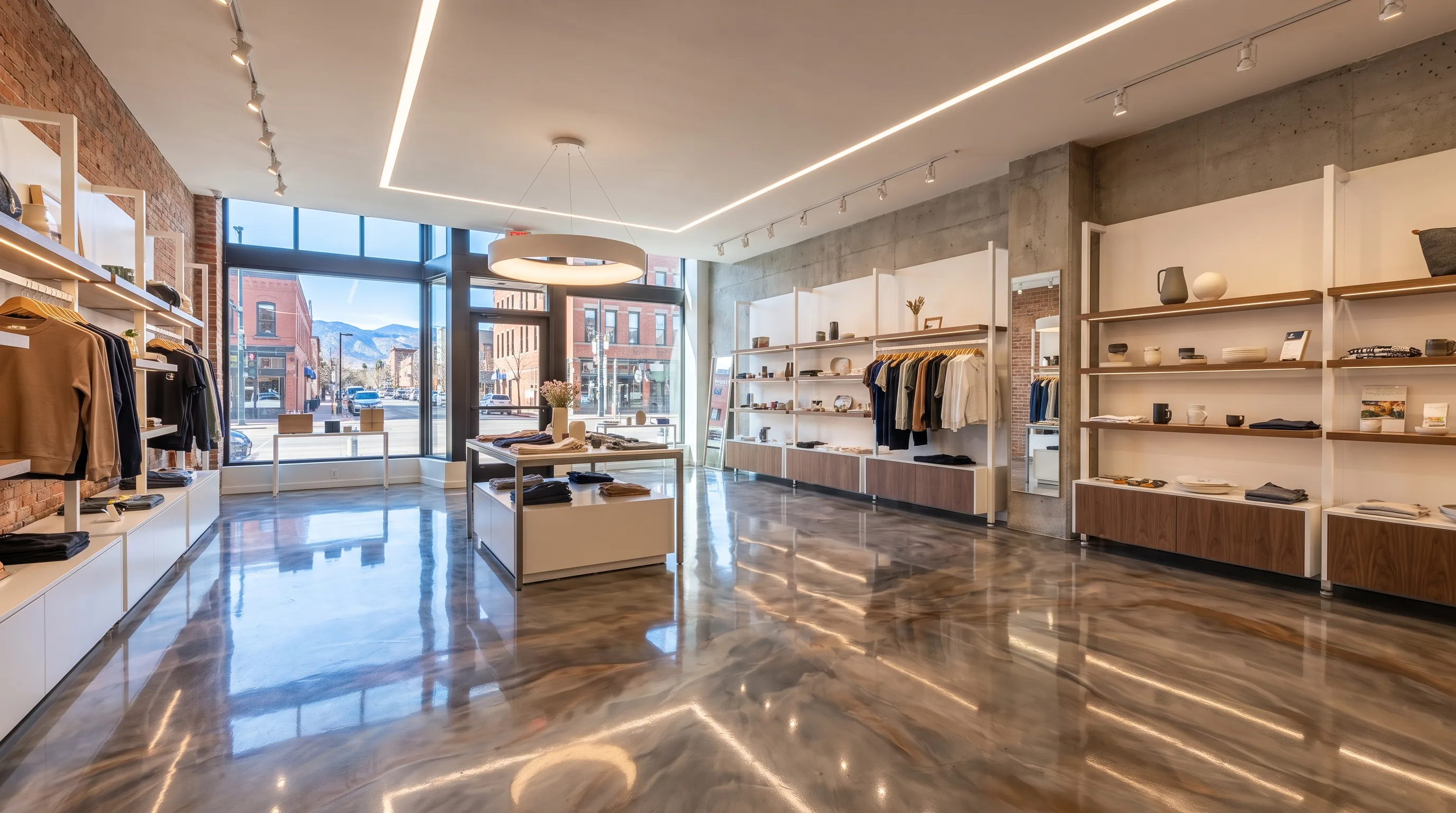
A high-gloss metallic epoxy floor in a Denver boutique retail space — installed overnight with zero lost sales days.
Plan around inventory, not just hours: The best scheduling window often isn't just "overnight" — it's overnight during a slower sales period or right before a planned reset, when fixture movement is already happening. Bringing us in early lets us align the install with your existing calendar rather than working around a fixed floor plan.
Cost for Typical Retail Square Footage
Retail pricing scales with square footage and finish level — a boutique storefront and a big-box footprint land in very different budget ranges, but the per-square-foot rate stays fairly consistent within a finish tier.
| Store Size | High-Gloss Solid | Metallic Premium |
|---|---|---|
| Boutique (1,000-2,000 sqft) | $5,000 – $14,000 | $8,000 – $22,000 |
| Mid-Size Store (3,000-5,000 sqft) | $15,000 – $35,000 | $24,000 – $55,000 |
| Large Format (8,000+ sqft) | $40,000+ | $64,000+ |
| Prep & RepairCracked slab or old flooring removal | Assessed on-site | |
Denver-Specific Considerations for Retail Floors
Retail floors in Colorado carry one extra requirement that stores in milder climates don't have to plan for: anything near an entrance sees the same seasonal exposure as a garage floor, just funneled through foot traffic instead of tires. Customers track in snow melt, road salt, and magnesium chloride residue every time they walk through the door during winter months, and that moisture and residue concentrates in a predictable zone near the entrance.
- Entry zones need the same UV-stable topcoat as exterior-adjacent floors. Even indoor retail floors near glass storefronts see meaningful UV exposure over years — a standard epoxy topcoat can visibly yellow in a sun-facing storefront window display area.
- Slip resistance matters more at entrances. A slight texture additive in the topcoat near entry zones specifically reduces slip risk from tracked-in snow melt, without changing the gloss look across the rest of the sales floor.
- Mag chloride resistance protects the finish. The same chemical resistance that protects a garage floor's topcoat from deicer residue keeps a retail entry zone from dulling or staining over a winter season.
None of this changes the overall look of the floor — it's the same high-gloss or metallic finish throughout the store — but it does mean the entry zone and any storefront-glass-adjacent area gets specified with the same climate considerations as an exterior floor, not treated as purely interior square footage.
Maintaining a Retail Epoxy Floor
Retail maintenance schedules are usually already built around daily or nightly cleaning routines, and an epoxy floor fits into that existing routine rather than adding to it. Daily maintenance is typically an auto-scrubber or dust mop pass during closing procedures — no waxing or periodic stripping and resealing the way VCT or some vinyl flooring requires. A degreaser or neutral cleaner handles anything tracked in during business hours.
The bigger maintenance consideration for retail specifically is protecting the finish during seasonal resets, when fixtures, shelving, and display units get moved across the floor. Felt pads or furniture sliders under heavy fixtures prevent scuffing during these moves, and it's worth building that habit into reset procedures from day one — a floor that's otherwise rated for years of foot traffic can still pick up avoidable scuff marks from dragged fixtures if nobody thinks to protect it during a reset.