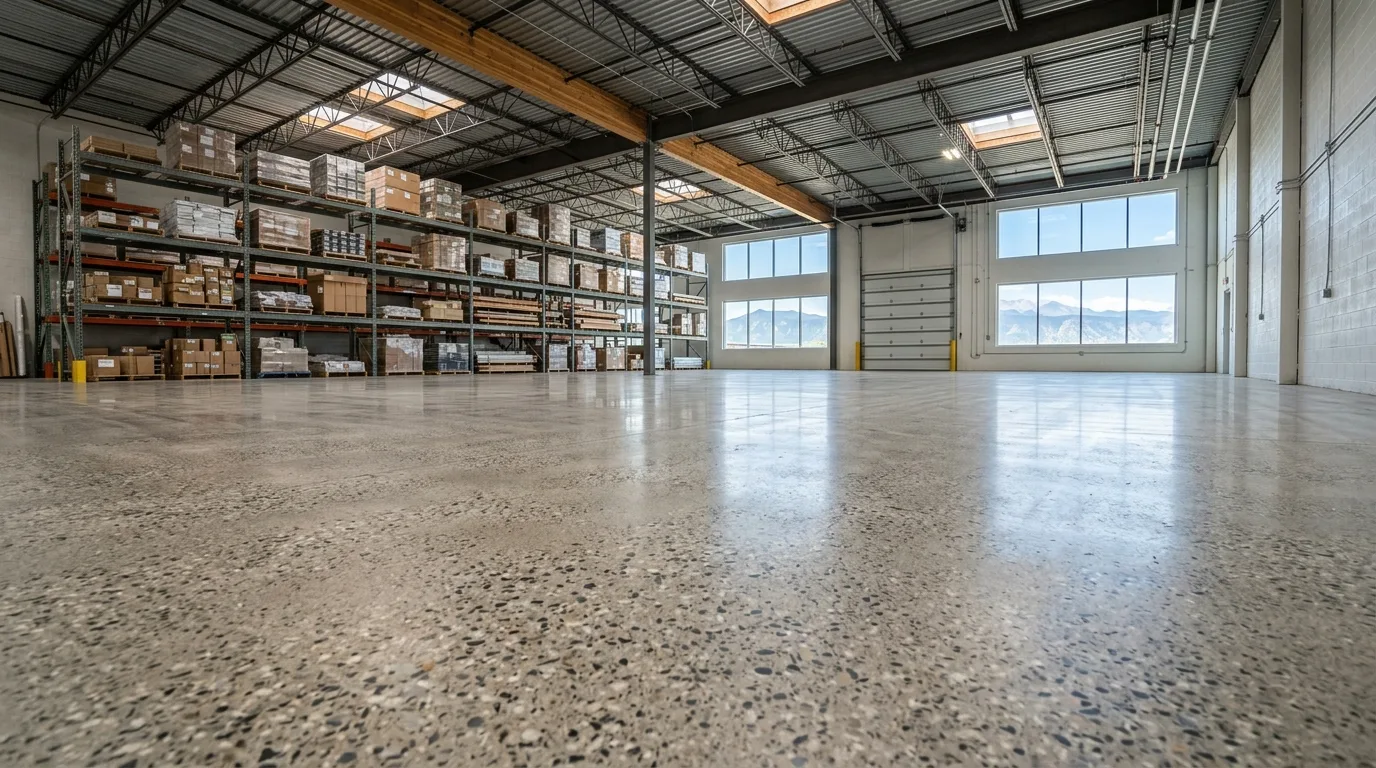
Not every concrete floor needs — or benefits from — a full multi-step diamond polish. Grind and seal is a lighter-touch process: a single or double-pass grind to open the surface and remove imperfections, followed by a penetrating or topical sealer to protect and add sheen. For Denver patios, warehouses, and budget-conscious commercial spaces, it delivers most of the visual and protective benefit of polished concrete at a fraction of the labor cost. See our concrete grind and seal service page for full process details.
What Grind and Seal Does to Concrete
Grind and seal uses coarser diamond tooling than a full polish sequence — typically stopping around 200–400 grit rather than progressing through the 8+ passes required for a true polished finish. This single or double pass opens surface pores, removes minor surface contamination and imperfections, and creates a lightly profiled surface ready to accept sealer.
Single-Pass Efficiency
One or two grinding passes versus the 6–8 passes required for full polish — significantly faster installation and lower labor cost.
Sealer Does the Work
Penetrating or topical sealer provides the protection and sheen that additional grinding passes would otherwise add — a more economical path to a finished look.
Natural Aggregate Look
Lighter grinding often reveals subtle aggregate texture without the aggressive exposure of full-polish grinding — a more understated, natural finish.
Ideal for Large Areas
Warehouses and large commercial floors benefit most from grind and seal's speed-to-cost ratio — full polish on huge square footage gets expensive fast.
Penetrating Sealer vs Topical Coating
The sealer choice matters as much as the grind level. Penetrating sealers (typically lithium or sodium silicate) chemically react with the concrete to densify it from within, leaving no surface film — invisible, breathable, and immune to peeling. Topical sealers (acrylic, epoxy, or urethane-based) sit on the surface as a film, adding more visible sheen and color enhancement but carrying peel and wear risk over time.
| Property | Penetrating Sealer | Topical Sealer |
|---|---|---|
| Application | Reacts chemically within concrete | Forms film on surface |
| Sheen level | Matte to low satin | Satin to high gloss |
| Peel/wear risk | None — not a surface film | Can peel or wear under traffic |
| Breathability | Allows vapor transmission | Can trap moisture vapor |
| Best for Denver | Patios, driveways, freeze-thaw zones | Interior floors, decorative accents |
| Reapplication | Rarely needed | Every 2–5 years depending on traffic |
For Denver's exterior applications — patios, driveways, pool decks — penetrating sealer is almost always the better choice. Freeze-thaw cycling and UV exposure at altitude are exactly the conditions that cause topical sealers to fail prematurely outdoors.
When Grind and Seal Beats Polished Concrete in Denver
- Large warehouse and industrial floors: Full polish across tens of thousands of square feet gets cost-prohibitive fast. Grind and seal delivers a clean, durable, dust-free floor at a fraction of the cost.
- Exterior patios and driveways: Penetrating sealer protects against Colorado's freeze-thaw and UV without the risk of peeling that some polished finishes carry outdoors.
- Budget-conscious commercial buildouts: Tenant improvement projects on tight timelines and budgets benefit from grind and seal's faster turnaround.
- Concrete in fair-to-good condition: Slabs with minor surface flaws that don't require the aggressive material removal of full polish.
Full polished concrete still wins where maximum reflectivity and a true mirror finish matter — retail showrooms, high-end residential living spaces. But for the majority of Denver commercial and exterior applications, grind and seal delivers comparable durability at meaningfully lower cost.
Cost of Grind and Seal in Denver
| Application | Sealer Type | Price Range |
|---|---|---|
| Warehouse / industrial floor | Penetrating densifier | $2–$3 / sq ft |
| Commercial interior | Topical satin sealer | $3–$4 / sq ft |
| Residential patio / driveway | Penetrating UV-stable sealer | $3–$5 / sq ft |
| Pool deck | Penetrating + slip additive | $4–$5 / sq ft |
Frequently Asked Questions
Low to medium satin sheen — opens pores and fills them without the full diamond polishing multi-step process. It's a middle ground between raw concrete and mirror-polished floors.
Yes — penetrating silicate sealer is UV-stable. Topical sealers should be UV-rated for Colorado's 5,280 ft exposure, where UV intensity runs roughly 25% above sea level.
Yes — penetrating sealer is excellent for patios, driveways, and pool decks exposed to Colorado UV and freeze-thaw. Unlike topical coatings, a penetrating sealer won't peel or blister from freeze-thaw moisture cycling.