Showrooms and flagship retail spaces have a floor requirement that most commercial categories don't: the floor itself has to look intentional, not just functional. Polished concrete is increasingly the answer for Denver retailers who want a floor that reads as a design choice rather than a maintenance item — a genuinely different proposition from a coating applied over concrete. This guide covers why showrooms specifically choose polished concrete, what it actually does for a space's lighting, and how it stacks up on cost against tile and epoxy for the same concrete polishing in Denver that ProEpoxy installs across the metro.
Why Showrooms Choose Polished Concrete Over Coatings
An epoxy or urethane coating is applied on top of concrete — it's a film that eventually wears, scuffs, or needs a recoat cycle no matter how well it's specified. Polished concrete is fundamentally different: it's the slab itself, mechanically ground and chemically densified into a harder, more reflective wear surface. There's no film to delaminate, no topcoat to schedule a recoat around, and no coating thickness to wear through under years of foot traffic.
For showrooms specifically, that translates into a floor that looks the same on day 3,000 as it did on day one, provided routine maintenance keeps up — a meaningful difference from a coated floor, which visibly ages as gloss and color shift even under proper care. It's also why polished concrete pairs so naturally with minimalist, design-forward retail spaces: the floor itself becomes a material choice on par with the fixtures and finishes around it, not a backdrop that has to be replaced when it starts to show wear. Designers specifying finishes for flagship stores increasingly treat the floor the same way they'd treat a stone or engineered surface — a permanent material decision rather than a wearable topcoat to be refreshed on a schedule.
Reflectivity and Lighting Efficiency Benefits
This is the benefit that's easy to underestimate until you see it in person. A high-gloss polished concrete floor reflects a meaningful portion of overhead and natural light back upward, which changes how a retail space actually reads — brighter, larger, and more evenly lit than the same space over a matte or absorbent floor material.
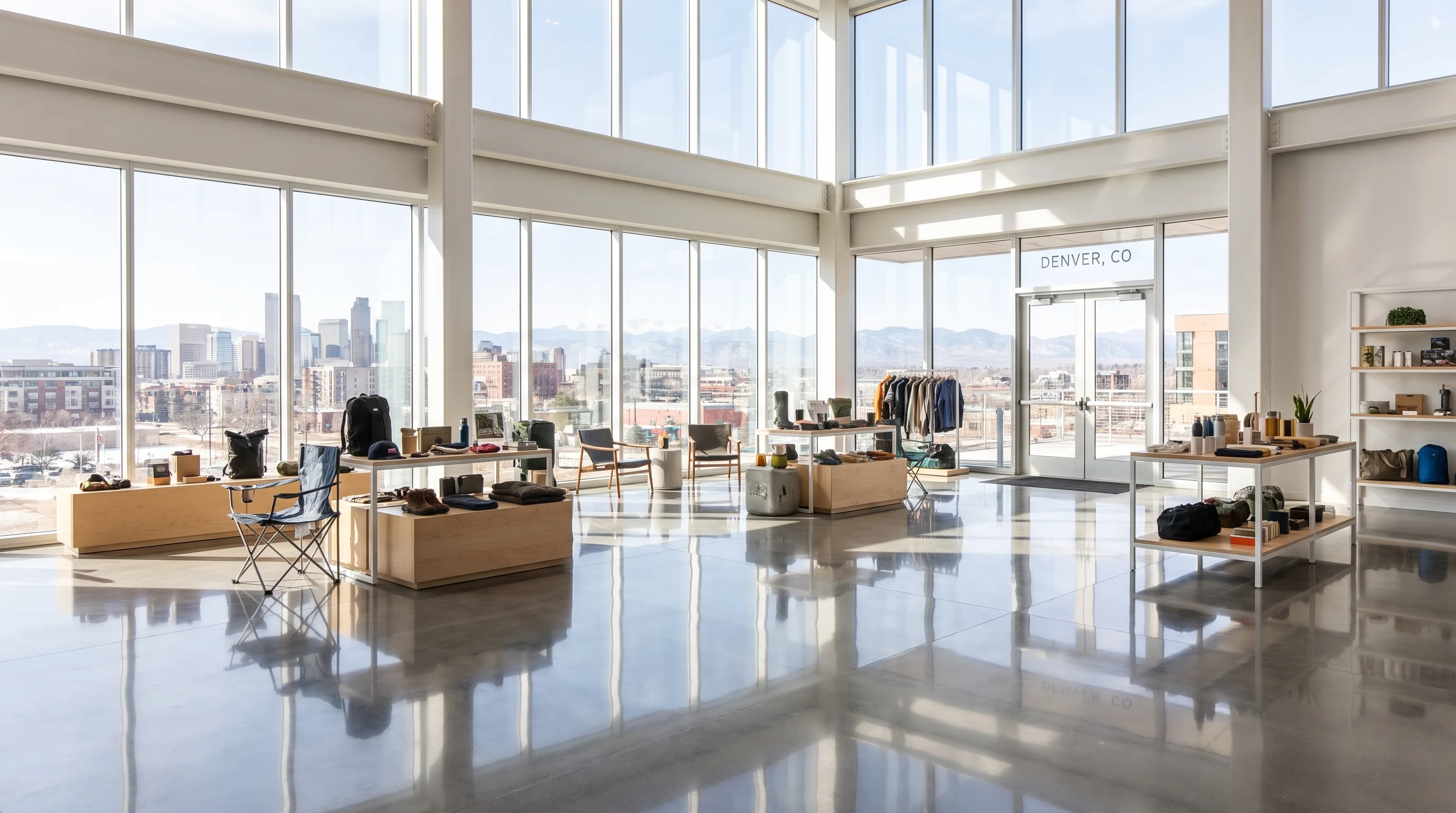
A mirror-finish polished concrete floor in a Denver showroom — reflectivity doubles as a design element, not just a floor.
Maintenance for High-Traffic Retail Floors
Polished concrete's maintenance profile is a major part of its appeal for retail operators managing daily cleaning schedules across possibly multiple locations. Daily maintenance is a dust mop or auto-scrubber pass — no waxing, no periodic stripping and resealing the way VCT or some vinyl flooring requires on a recurring schedule.
The densifier treatment applied during polishing is a permanent chemical hardening of the slab itself, not a topical layer that wears off, so the floor's core durability doesn't degrade the way a coating's protective layer does over years of traffic. What does eventually soften is surface gloss under heavy sustained foot traffic — addressed with a periodic burnish pass roughly every 1-2 years depending on volume, rather than a full recoat or redo.
Multi-location consistency: For retail chains managing several Denver-metro locations, polished concrete's low, predictable maintenance schedule is often easier to standardize across stores than a coated floor, where recoat timing can vary by location based on traffic and prior installation quality.
Cost Compared to Tile and Epoxy
Polished concrete's upfront cost sits competitively against both tile and epoxy once you account for what each option actually requires over its service life, not just the initial install price.
| Flooring Option | Upfront Cost / Sq Ft | Ongoing Maintenance |
|---|---|---|
| Polished ConcreteDiamond ground, densified | $3 – $10 | Dust mop, periodic burnish |
| Commercial TilePorcelain or ceramic | $8 – $15 | Grout cleaning, periodic replacement |
| High-Gloss EpoxySolid or metallic system | $5 – $9 | Recoat cycle every 10-15 years |
Tile typically costs more upfront and carries ongoing grout maintenance plus the risk of individual cracked or chipped tiles in a customer-facing space. Epoxy costs less upfront in many cases but eventually needs a full recoat, which means a period of reduced store access during that redo. Polished concrete's combination of moderate upfront cost and minimal ongoing intervention is what makes it competitive for retailers thinking in terms of total cost over a 15-20 year lease term rather than just the initial buildout budget.
Denver-Specific Considerations for Retail Slabs
Not every existing slab is ready for a mirror-finish polish, and this is a genuinely Denver-specific evaluation. Colorado's clay-heavy soils in several metro submarkets mean slab moisture content and historical settling vary more than in regions with more uniform soil composition, both of which affect how a slab grinds and whether the final aggregate exposure looks consistent across the floor.
- Slab age and prior sealers. Older Denver retail slabs sometimes carry a sealer or curing compound from original construction that has to be fully removed before grinding — skipping this step causes inconsistent gloss and bonding issues with the densifier.
- Moisture testing before committing to gloss level. A calcium chloride vapor test tells us whether the slab can safely support a high-gloss finish or whether a lower sheen with a moisture-tolerant sealer is the more reliable choice.
- Storefront glass and UV exposure. Polished concrete doesn't carry the same UV-yellowing risk that a standard epoxy topcoat does, which is one advantage over coatings for sun-exposed storefront floor areas specifically.
None of these factors rule out polishing for most Denver retail spaces — they're simply part of the on-site assessment that determines the realistic gloss level and whether any slab prep is needed before grinding begins, the same evaluation that happens before any polishing quote is finalized.
Design Considerations Beyond the Finish
Gloss level is the headline decision, but a few other choices shape how a polished floor reads in a retail environment specifically.
Aggregate exposure — how much of the underlying stone aggregate shows through the polish — is a deliberate design choice made early in the grinding sequence. A full aggregate exposure gives a more textured, natural stone look; a minimal exposure keeps the floor reading as a clean, uniform gray plane, which is more common in minimalist retail design. Staining or dyeing before polishing is also an option for retailers wanting a specific color tone rather than concrete's natural gray-to-tan range, though this adds a step to the process and is decided before grinding begins, not after.