A full garage or small commercial floor, coated and drivable in a single day, sounds like a marketing claim until you understand the chemistry behind it. Polyaspartic's cure speed is real and repeatable — it's the reason ProEpoxy can offer genuine 1-day timelines on polyaspartic floor coating in Denver for straightforward jobs, while other systems simply can't compress the same work into the same window. This guide explains why the chemistry works, what actually happens on install day, and — just as importantly — when a 1-day timeline isn't the realistic answer.
Why Polyaspartic Cures So Much Faster Than Epoxy
Standard epoxy cures through a chemical reaction that typically needs 24-72 hours to reach a durable, walkable state, and full cure can take a week or more. Polyaspartic is a different resin chemistry entirely — it reacts faster and more completely in a shorter window, reaching light-traffic readiness in 4-6 hours and general functional cure within 24 hours. That's not a marketing simplification; it's a genuine chemical difference in reaction speed between the two resin classes.
That speed is also largely independent of humidity, which matters in a practical sense — some coating chemistries slow down significantly in humid conditions or need very specific temperature windows to cure correctly. Polyaspartic's reaction proceeds reliably across a wider range of conditions, which is part of why it's the material that makes a genuine 1-day install schedule possible rather than aspirational. Standard epoxy topcoats, by contrast, simply cannot be walked on the same day they're applied without risking a compromised finish — the chemistry hasn't progressed far enough, regardless of how the job is scheduled or staffed.
What Happens During a 1-Day Install
A true 1-day install isn't a rushed version of a normal install — it's the same process, sequenced tightly because the materials allow it. Here's what a straightforward garage floor looks like start to finish.
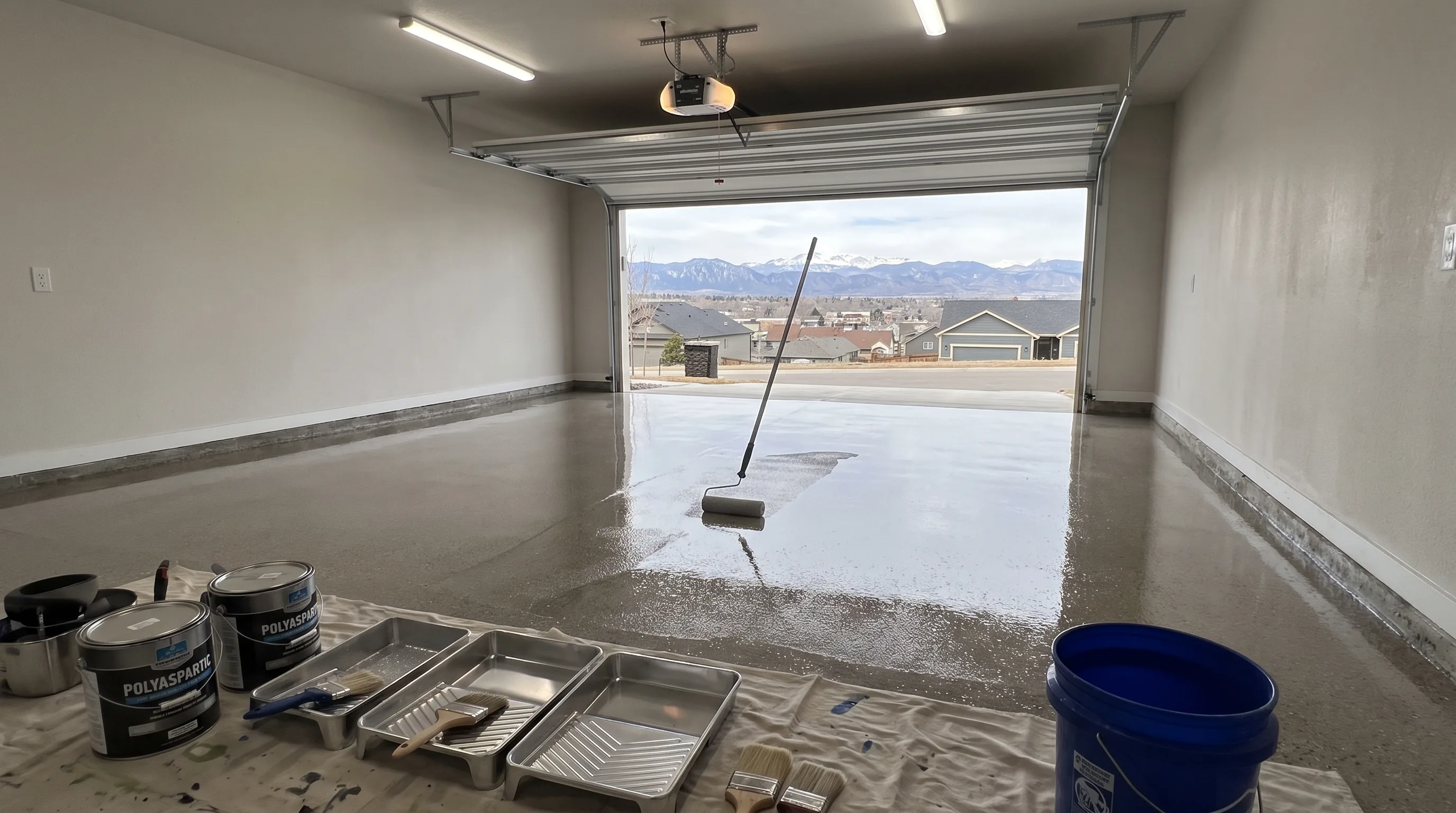
The polyaspartic topcoat stage — applied same-day thanks to the resin's fast-cure chemistry.
When 1-Day Timelines Aren't Realistic
Being upfront about this is part of setting expectations correctly — not every floor is a 1-day candidate, and forcing a rushed timeline onto a floor that needs more prep produces a worse result, not a faster good one.
Honesty on scheduling: We assess this on-site before quoting a 1-day timeline — not after starting. If your slab needs more than straightforward prep, we'll say so upfront and give you an accurate 1.5-2 day estimate rather than starting a 1-day job and running into a rushed finish.
Cost of Fast-Track Installs
A genuine 1-day install doesn't carry a premium over a standard 1-2 day timeline for the same system — the speed comes from the material chemistry, not from cutting corners or charging extra for compressed labor. Pricing is driven by the same factors as any garage floor: size, system selected, and prep needs.
| Garage Size | Standard Flake System | Realistic Timeline |
|---|---|---|
| 1-Car (~250 sqft)Straightforward prep | $1,000 – $1,750 | Same day |
| 2-Car (~450 sqft)Straightforward prep | $1,800 – $3,200 | Same day |
| 3-Car (~650 sqft)Straightforward prep | $2,600 – $4,550 | 1-1.5 days |
| Any Size, Extensive RepairCracks, old coating removal, moisture barrier | Assessed on-site | 1.5-2+ days |
How Denver's Altitude Factors Into a Fast Timeline
A 1-day install still has to respect Denver's elevation-specific cure behavior, even though polyaspartic compresses the overall timeline dramatically. Lower air pressure at 5,280 ft changes cure rate and pot life for every coating layer in the system, not just the topcoat — primer, base coat, and topcoat all react slightly differently here than they would at sea level, and a crew running from generic manufacturer cure charts rather than altitude-adjusted timing can either rush a layer that isn't ready or waste time over-waiting on one that already is.
This is where experience compounds the speed advantage rather than working against it. A crew that knows exactly how each layer behaves at Denver's elevation can sequence the day tightly without guessing — moving to the next step the moment a layer is genuinely ready, rather than padding in extra buffer time out of caution. That precision is part of what makes a true 1-day timeline achievable here specifically, versus a contractor unfamiliar with high-altitude application defaulting to a more conservative, slower schedule.
Getting the Most Out of a Fast Install
A few things on the homeowner or business side help a 1-day timeline go smoothly rather than becoming a rushed scramble.
- Clear the space completely before the crew arrives. Every item left in a garage or commercial space has to be moved before grinding starts — doing this the night before rather than during the assessment saves real time on install morning.
- Plan vehicle and equipment access around the full cure window. Walk-on readiness at 4-6 hours isn't the same as full drive-on readiness at 24 hours — plan parking elsewhere overnight even on a same-day install.
- Flag any known slab issues before the on-site assessment. Mentioning a known crack, prior coating, or moisture concern up front lets us give an accurate 1-day-or-not answer during the initial conversation rather than discovering it as a surprise on install morning.