Polyaspartic is the single material decision that determines whether a Denver floor coating survives Colorado's climate or fails within a couple of years. It's not a replacement for epoxy — it's a topcoat chemistry that solves problems epoxy alone can't handle at altitude: UV stability, freeze-thaw flexibility, and fast cure. This guide explains what polyaspartic actually is, how it differs from standard epoxy, and why ProEpoxy specifies it as standard on every polyaspartic floor coating project in Denver rather than treating it as a premium upgrade.
What Polyaspartic Is and How It Differs From Epoxy
Polyaspartic is a type of polyurea coating built on an aliphatic resin base, chemically distinct from epoxy resin. The key structural difference is in the resin's molecular bonds: standard epoxy resin is aromatic, meaning its chemical bonds absorb UV radiation and break down over time — that's what causes epoxy to yellow and chalk in sunlight. Aliphatic polyaspartic resin doesn't have those UV-reactive bonds, so it stays clear and stable indefinitely under sun exposure.
The two materials aren't really competitors — in a correctly built floor system, epoxy is the structural base coat (excellent adhesion, gap-filling body, cost-effective bulk) and polyaspartic is the topcoat (UV stability, chemical resistance, fast cure). Calling a floor "polyaspartic" usually means epoxy base plus polyaspartic topcoat, not polyaspartic used as the entire system, though polyaspartic can be used as a standalone base-and-top system in some commercial applications where its faster cure outweighs epoxy's lower material cost.
Why It's the Standard Topcoat for Colorado
At Denver's 5,280 ft elevation, UV intensity runs roughly 25% higher than at sea level. A standard epoxy topcoat exposed to that UV load — through a garage window, an open door, or any commercial storefront glass — visibly yellows within one Colorado summer. Polyaspartic simply doesn't have that failure mode, which is why it's not treated as an optional upgrade on ProEpoxy installs; it's specified as standard.
Cure Time and Install Speed
Cure speed is one of polyaspartic's most practical advantages, and it's what makes phased commercial and warehouse installs realistic in the first place. A standard epoxy topcoat can take 24-72 hours before it's ready for any meaningful traffic. Polyaspartic reaches light foot-traffic readiness in 4-6 hours and is generally considered fully cured within 24 hours.
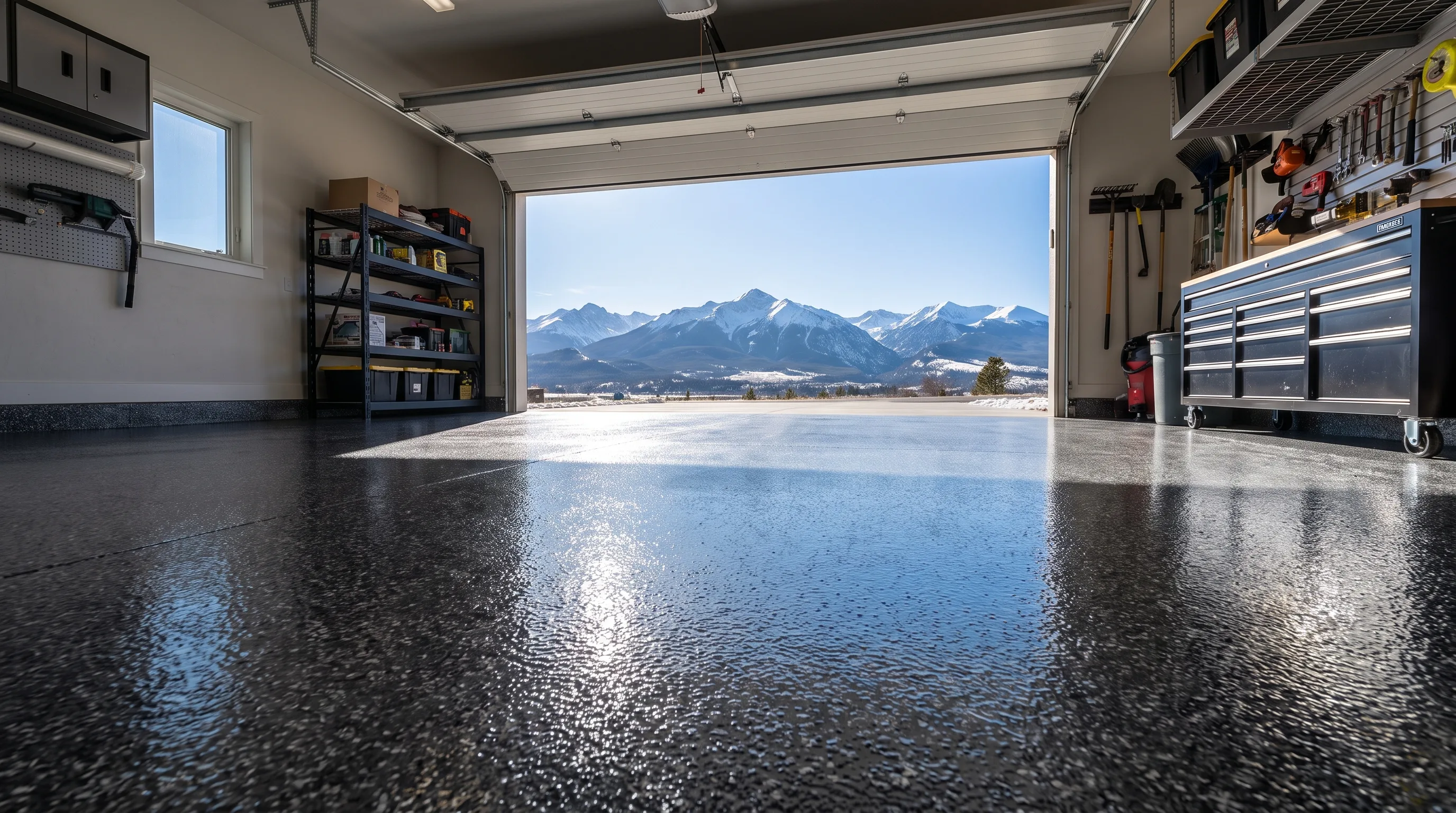
A polyaspartic-topped floor system — UV-stable finish holding gloss and color under direct Colorado sun exposure.
That speed comes from the chemistry itself — polyaspartic reacts and cures through a faster mechanism than epoxy's cure process, largely independent of humidity, which also makes it more forgiving to apply in Denver's variable seasonal conditions than moisture-sensitive alternatives. It's the reason a residential garage can go from bare concrete to drive-on-ready in a single day, and why warehouse zones coated overnight can often reopen to light traffic the next shift. For commercial and industrial clients specifically, this cure speed is often the deciding factor in choosing polyaspartic over a cheaper alternative — the material cost difference is frequently smaller than the value of the downtime avoided by cutting cure time from days to hours.
One tradeoff to know: polyaspartic's fast cure also means a shorter working window (pot life) for the installer — it has to be mixed and applied correctly the first time. This is a place where installer experience genuinely matters more than with slower-curing materials.
Cost and Value Over Time
Polyaspartic topcoat material costs more per square foot than a standard epoxy topcoat, but the comparison only makes sense as part of the full system cost and lifespan — not as a standalone line item.
| System | Typical Lifespan in Denver | Added Cost / Sq Ft |
|---|---|---|
| Epoxy Base + Standard Epoxy TopcoatNot UV-stable | 2-3 years before yellowing/failure | Baseline |
| Epoxy Base + Polyaspartic TopcoatUV-stable, freeze-thaw rated | 15-20 years | +$0.75 – $1.50 |
| Full Polyaspartic Base + TopcoatCommercial fast-turnaround jobs | 15-20 years | +$2 – $4 |
The math is straightforward once you factor in a full recoat: a standard epoxy topcoat that needs replacing every 2-3 years costs far more over a 15-year period than a polyaspartic topcoat installed once and left alone. In Denver specifically, this isn't a marginal difference — it's the gap between a floor that needs to be redone multiple times and one that doesn't.
Where Polyaspartic Makes the Biggest Difference
Polyaspartic isn't equally important everywhere on a property — its value scales directly with UV and temperature exposure. Here's where it matters most in a typical Denver home or business.
- Garages with windows or east/west-facing doors. Any garage that sees direct or strong indirect sunlight through glass or an open door needs polyaspartic — this is the single most common place a standard epoxy topcoat fails visibly.
- Loading docks and exterior-adjacent commercial floors. Any space where the coating extends near an exterior door sees the same UV and freeze-thaw stress as a garage floor.
- Parking structures and traffic decks. Constant exposure to sun, snow, ice, and deicing salt makes polyaspartic's chemical and freeze-thaw resistance essential rather than optional.
- Restaurant and commercial kitchens. Fast cure time minimizes downtime, and chemical resistance holds up against grease, cleaning agents, and hot equipment traffic.
- Fully interior, north-facing spaces with no sun exposure. The one scenario where the UV argument matters less — though freeze-thaw and fast cure often still make polyaspartic worthwhile even here.
Common Mistakes When Specifying Polyaspartic
Because polyaspartic performs so much better than standard epoxy in Colorado's climate, it's easy to assume any topcoat labeled "polyaspartic" delivers the same result. A few things are worth checking before signing a quote.
Not all polyaspartic products are equal. Formulations vary in solids content, UV inhibitor package, and film build — a diluted or low-grade polyaspartic can still underperform compared to a properly specified full-solids product, even though it's technically the correct material class. Ask what specific product line is being used, not just the generic material name.
Applying it as a single coat when two are specified. Most Colorado-rated systems call for two coats of polyaspartic topcoat for full UV protection and durability. A single-coat application can leave thin spots that wear through faster than the rest of the floor.
Ignoring pot life during application. Polyaspartic's fast cure means a genuinely short working window once mixed — a crew moving too slowly can end up with lap marks or uneven texture where sections were applied at different points in the cure. This is a place where installer speed and experience directly affects the finished look, not just the durability.