Polyurea and polyaspartic get confused for each other constantly — both are fast-curing, both outperform standard epoxy topcoats, and polyaspartic is actually a chemical subclass of polyurea, which adds to the confusion. But they behave differently enough in practice that choosing the wrong one for your project either overspends the budget or underdelivers the performance you actually need. This guide breaks down the real differences and gives a clear answer on which one fits which application, using the same comparison ProEpoxy runs internally when specifying polyurea or polyaspartic systems for Denver projects.
Chemistry Differences That Actually Matter
Technically, polyaspartic is a type of aliphatic polyurea — the two aren't entirely separate material families. But in flooring industry usage, "polyurea" typically refers to pure polyurea systems (faster-reacting, more elastic, often applied by plural-component spray equipment), while "polyaspartic" refers to a specific polyurea variant formulated to react more slowly than pure polyurea, giving installers a longer working window while still curing far faster than standard epoxy.
That reaction speed difference is the practical distinction that matters for your project. Pure polyurea's near-instant reaction makes it harder to work by hand roller — it's typically spray-applied by trained crews with specialized equipment. Polyaspartic's slightly slower reaction keeps it workable with standard roller application while still curing dramatically faster than epoxy, which is why it's become the default topcoat for most residential and light commercial Denver floors, while pure polyurea is reserved for applications that specifically need its added speed or flexibility.
Cure Speed Comparison
Both materials are fast relative to standard epoxy, but the gap between them is still significant for time-sensitive projects.
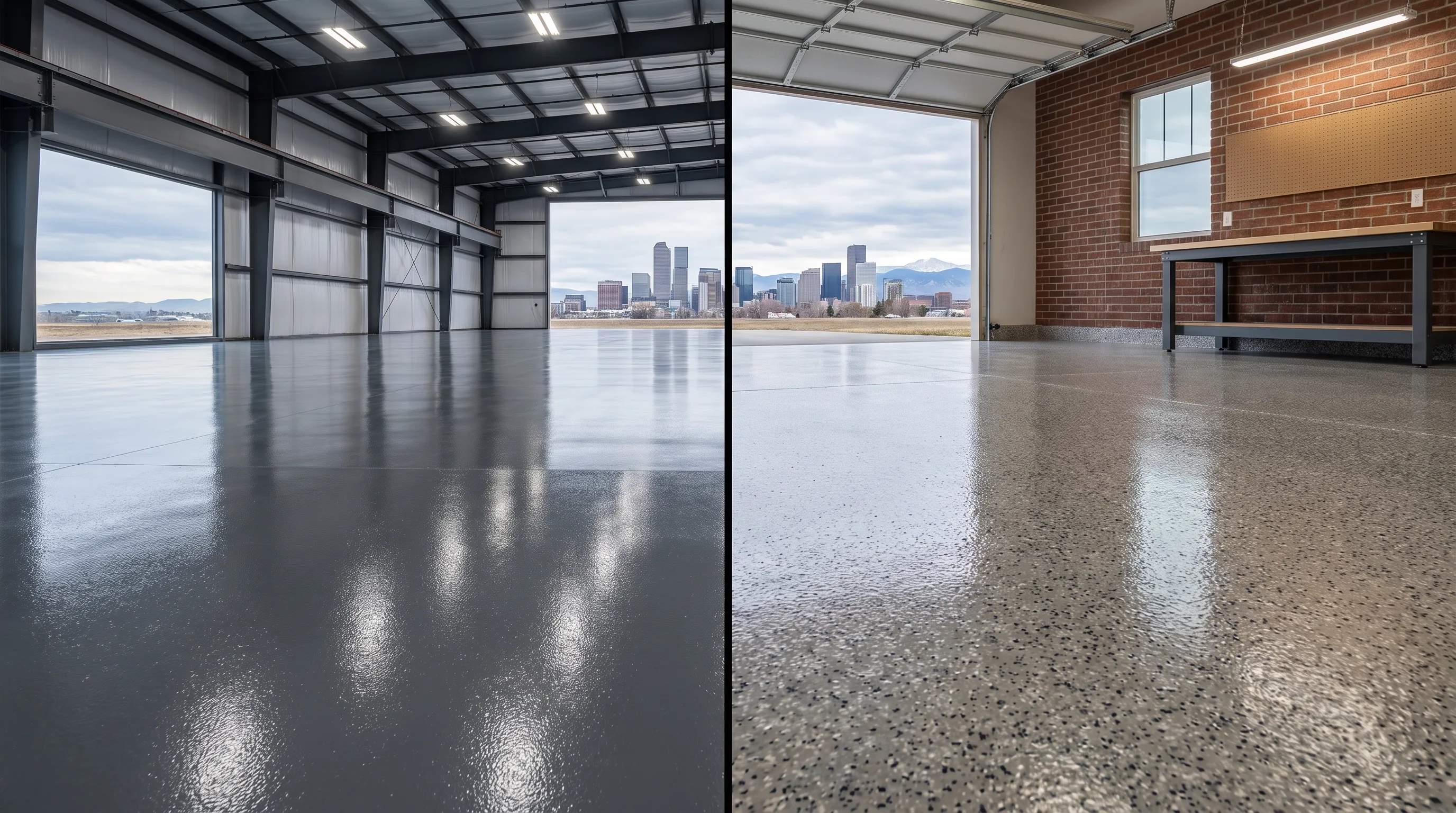
Polyurea (left) and polyaspartic (right) both outperform standard epoxy — the right choice depends on flexibility needs and application scale.
Temperature Flexibility and Application Range
This is where the two materials diverge most in real-world performance. Polyurea remains elastic across a wider temperature range than polyaspartic, which matters directly for Denver's climate — 150+ annual freeze-thaw cycles and significant daily temperature swings put real flexing stress on any coating, and polyurea absorbs that stress with less risk of micro-cracking over time.
Polyaspartic is also freeze-thaw rated and UV-stable — it's not a poor performer in Colorado's climate by any means, which is why it's the standard topcoat on the vast majority of Denver garage and commercial floors. But for applications with genuinely extreme temperature exposure or structural movement — elevated parking decks, cold storage facilities, traffic-bearing membranes — polyurea's additional flexibility is the more conservative, better-performing choice. The distinction isn't about which material is more durable in the abstract; it's about which one's flexibility profile actually matches what the specific structure underneath it does under thermal stress.
The practical rule: If the floor is a static slab-on-grade with normal seasonal exposure, polyaspartic delivers everything you need at lower cost. If the structure genuinely flexes, moves, or sees extreme temperature swings — think elevated decks or freezer floors — polyurea's flexibility earns its premium.
Which One Costs More and Why
Polyurea consistently costs more per square foot than polyaspartic, driven by both material cost and the specialized spray application equipment and trained crews it requires.
| Factor | Polyurea | Polyaspartic |
|---|---|---|
| Typical Cost Add-OnOver standard epoxy topcoat | +$2 – $4/sqft | +$0.75 – $1.50/sqft |
| Application Method | Specialized spray equipment | Standard roller application |
| Best Fit | Decks, membranes, extremes | Garages, retail, most commercial |
| UV Stability | Excellent | Excellent |
For most Denver homeowners and standard commercial floors, polyaspartic delivers the UV stability and freeze-thaw performance needed without the added spray-application premium. Polyurea's higher cost is justified specifically by projects that need its faster cure or greater flexibility — not as a general upgrade over polyaspartic for a typical garage or retail floor.
Hybrid Systems: Getting Both in One Floor
The two materials aren't mutually exclusive, and in commercial and industrial applications, combining them is common practice rather than an edge case. A polyurea base coat provides the flexibility and rapid buildup needed on a demanding substrate, while a polyaspartic topcoat delivers the UV stability, gloss, and cost efficiency that a full polyurea system doesn't need to provide on its own.
This hybrid approach shows up most often on parking structures and industrial floors where the base needs to handle structural movement or moisture exposure that favors polyurea's properties, but the visible wear surface doesn't need polyurea's full flexibility — polyaspartic's UV-stable, cost-effective chemistry handles that layer just as well as it would on a standalone system. Specifying a hybrid isn't a compromise; it's matching each layer's material properties to the specific job that layer actually has to do.
How to Decide Which One You Need
Working through a short set of questions usually settles the decision quickly, before ever comparing quotes:
- Does the structure flex or move? Elevated decks, structures with expansion joints, or anything experiencing real structural movement point toward polyurea or a polyurea base.
- Is this a genuine waterproofing application? Membrane-grade waterproofing needs, like a traffic deck over occupied space below, favor polyurea's elastic, seamless properties.
- Is speed the primary constraint? If a project genuinely cannot tolerate more than a few hours of downtime, polyurea's near-instant cure may justify its cost premium even on an otherwise standard application.
- Is this a standard slab-on-grade with normal exposure? Garages, retail floors, and most commercial spaces without unusual movement or waterproofing needs are well served by polyaspartic at a lower cost.
Most Denver projects land in that last category, which is why polyaspartic remains the default topcoat across the majority of ProEpoxy installs — polyurea is specified when the project's actual requirements call for it, not as a default upsell.