Forklift traffic is the single most demanding condition a warehouse floor faces — concentrated tire loads, constant turning stress at aisle ends, and repeated point loading that no standard commercial coating is built to absorb. This guide covers exactly what forklift traffic does to an under-specified floor, how a forklift-rated system is built to resist it, and where floors typically fail first when they aren't. It's the specification standard behind every warehouse epoxy flooring project ProEpoxy installs for Denver distribution and logistics facilities.
What Forklift Traffic Does to Standard Floor Coatings
A loaded forklift concentrates enormous weight onto a small tire contact patch — far more concentrated than the distributed weight of foot traffic or even most other wheeled equipment. Solid rubber and polyurethane forklift tires in particular generate significant shear force during turns and stops, which is exactly the kind of stress a thin-mil standard epoxy coating (built for light commercial foot traffic) simply isn't formulated to resist.
The failure pattern is predictable and shows up in a specific sequence: first, surface wear and dulling in the most-traveled lanes; then, as the topcoat thins under repeated tire contact, exposure of the base coat; and finally, delamination or chipping at the edges of wear zones, particularly where forklifts turn or brake. A standard coating specified for a warehouse without accounting for actual forklift traffic volume will show this pattern within one to two years in high-use aisles, long before the rest of the floor shows any wear at all. By the time base coat exposure is visible, the floor isn't just cosmetically worn — the exposed area has lost the wear-resistant layer entirely, meaning any further traffic accelerates damage to the slab underneath rather than to a sacrificial coating layer designed to take that wear.
Broadcast Aggregate and Mil Thickness for Heavy Loads
The fix isn't a different type of epoxy — it's a different system build. Forklift-rated floors get their durability from two specific factors working together.
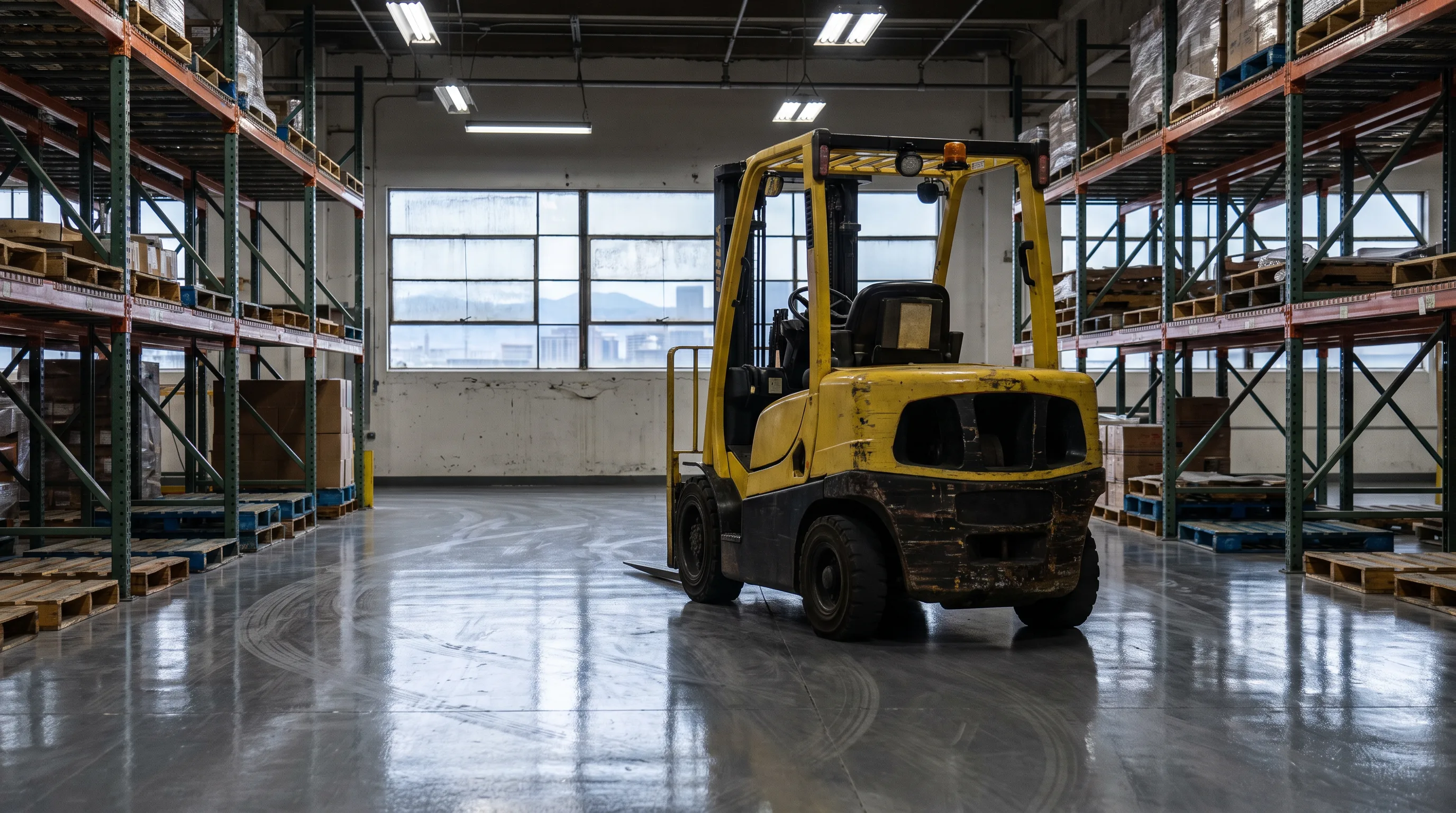
A forklift-rated 20-mil broadcast system in an active Denver warehouse aisle, built to resist concentrated wheel loads.
Point-Load Resistance at Racking and Turns
Wear on a warehouse floor is almost never uniform — it concentrates in specific, predictable zones, and understanding where lets us specify extra protection exactly where it's needed rather than over-building the entire floor unnecessarily.
Turning zones at the end of racking aisles see the highest shear stress, since a forklift pivoting under load twists tire contact against the floor rather than simply rolling across it. Racking aisle centerlines take the most repeated straight-line wheel passes over the life of the floor. Staging and loading dock areas combine heavy point loads from parked, loaded forklifts with the temperature and moisture exposure of nearby dock doors. Mapping these zones before installation lets us specify additional broadcast density or mil thickness exactly where the floor needs it most, rather than treating the entire warehouse as a single uniform traffic zone.
A floor that fails in patches, not sheets: If you're evaluating an existing warehouse floor, wear concentrated in turning zones and aisle centerlines — while the rest of the floor still looks fine — is the clearest sign the original system was under-specified for actual forklift traffic, not a sign of a bad slab.
Cost for Forklift-Rated Systems
Forklift-rated systems cost more per square foot than general commercial coatings because of the added mil thickness and broadcast density — but the cost difference is minor compared to the cost of redoing an under-specified floor within a few years under sustained heavy use.
| System | Best For | Cost / Sq Ft |
|---|---|---|
| Standard Commercial8-12 mil, light traffic | Office, retail — not forklift traffic | $5 – $7 |
| Forklift-Rated Broadcast20+ mil, aggregate broadcast | Active distribution & warehousing | $9 – $12 |
| Heavy-Duty Zone ReinforcementExtra broadcast at turns/aisles | High-volume 24/7 operations | +$1 – $2 per zone |
| Crack & Joint RepairAdd-on if needed | Assessed on-site | Varies by scope |
Denver-Specific Factors That Compound Forklift Wear
Forklift wear isn't the only stress a Denver warehouse floor absorbs, and the two factors interact in ways that make an under-specified floor fail faster here than in a milder climate.
- Freeze-thaw cycling near dock doors. Denver sees 150+ freeze-thaw cycles a year, and any warehouse zone near an active loading dock experiences that same temperature swing. A coating already stressed by concentrated forklift loads has less flexibility left to absorb freeze-thaw expansion and contraction, which accelerates cracking in exactly those high-traffic dock approach zones.
- Mag chloride and road salt tracked in. Forklifts and foot traffic both bring in deicer residue during winter months, and that residue is chemically corrosive to a coating that isn't rated to resist it — compounding the mechanical wear from tire traffic with chemical degradation in the same wear zones.
- Altitude-adjusted cure on repair work. When a worn zone eventually needs a targeted recoat rather than a full floor redo, the patch has to cure correctly at Denver's elevation to bond properly with the surrounding floor — a generic sea-level cure schedule on a spot repair can leave a soft transition edge that wears unevenly against the original coating.
None of this changes the core forklift-rated spec — 20+ mil broadcast system, correctly mapped to traffic zones — but it does mean the topcoat chemistry needs the same freeze-thaw and chemical resistance rating that a residential garage or exterior-adjacent commercial floor requires, layered on top of the mechanical durability forklift traffic demands.
Extending the Life of a Forklift-Rated Floor
Even a correctly specified forklift-rated system benefits from a few operational habits that extend its service life well past the baseline 15-20 year expectation.
Rotating primary traffic lanes where the warehouse layout allows distributes wear more evenly rather than concentrating it permanently in one path. Addressing minor surface wear with a targeted topcoat recoat before it progresses to base-coat exposure is far less disruptive and less expensive than waiting for a full system failure that requires regrinding and a complete redo. And keeping forklift tires clean of embedded debris — small stones or metal fragments picked up outdoors and tracked onto the coated floor — prevents the kind of localized gouging that a otherwise well-specified system isn't designed to resist.