A warehouse floor works harder than almost any other commercial flooring category — constant forklift traffic, rack leg point loads, chemical exposure from stored inventory, and abrasion from pallet jacks and steel wheels, all day, every day. A residential-grade epoxy system installed in a warehouse will fail within a year or two under that load. This guide covers what an actual forklift-rated warehouse epoxy flooring system requires in Denver, what it costs, and how we install it without shutting your operation down.
Why Warehouses Need a Different Epoxy System
The system that works in an office lobby or even a retail floor is not built for what a warehouse puts a slab through. Rack leg point loads concentrate enormous pressure on tiny footprints. Forklift tires — especially solid rubber or polyurethane wheels — generate friction and shear stress standard epoxy wasn't designed to absorb. Add chemical exposure from stored materials, cleaning agents, or fuel drips, and a warehouse floor is really an industrial-grade engineering problem, not a decorative coating job.
That's why warehouse systems specify higher mil thickness (the total dry film build of the coating), forklift-rated aggregate broadcast for slip resistance and load distribution, and a topcoat chemistry chosen for chemical resistance rather than gloss. In Denver, all of that still has to sit on top of the same altitude-adjusted cure process and freeze-thaw-rated base that every coating in this climate needs — a warehouse floor exposed to loading dock doors that open to the outside sees the same UV and freeze-thaw stress as a garage floor, just with far more traffic on top of it.
Forklift and Heavy Traffic Load Ratings
Load rating isn't a single number — it's a combination of coating thickness, aggregate broadcast density, and substrate condition working together. Here's what actually determines whether a warehouse floor holds up under sustained forklift and rack traffic.
Chemical and Abrasion Resistance
Most warehouse floor failures that aren't load-related come down to chemical attack — a spilled solvent, hydraulic fluid, or aggressive cleaning chemical that a standard epoxy topcoat wasn't formulated to resist. We specify topcoat chemistry based on what's actually stored and handled in your facility: novolac epoxy or polyurea systems for aggressive chemical exposure, standard polyaspartic for general-purpose warehousing with routine cleaning.
Abrasion resistance follows the same logic. A floor with constant pallet jack and forklift traffic wears differently than one with occasional foot traffic, and the aggregate broadcast density and topcoat hardness both get specified around your actual traffic volume rather than a generic industrial default. Steel wheel traffic in particular is a case where getting the topcoat hardness wrong shows up fast — a topcoat too soft for steel-wheeled cart traffic will scuff and gouge within weeks, while one too brittle for the facility's temperature swings can crack under repeated impact loading near dock doors.
This is also where Denver's climate reasserts itself even inside a warehouse. Loading dock areas exposed to outside air temperature swings see the same freeze-thaw stress as an exterior slab, and any zone near a dock door that sees direct sun gets the same UV load as a garage floor. Specifying one uniform interior-only system across a facility with active dock doors is a common way warehouse coatings underperform in this market specifically.
Tell us what you store: The single most useful piece of information for specifying your system correctly is a list of the chemicals, fuels, or materials regularly present on the floor. This drives topcoat selection more than almost any other factor.
Phased Installation to Avoid Downtime
Warehouses can't stop operating for a floor coating — inventory still needs to move, orders still need to ship. The solution is sectioning the floor into zones and coating them sequentially, usually overnight or over a weekend, so the rest of the facility keeps running.
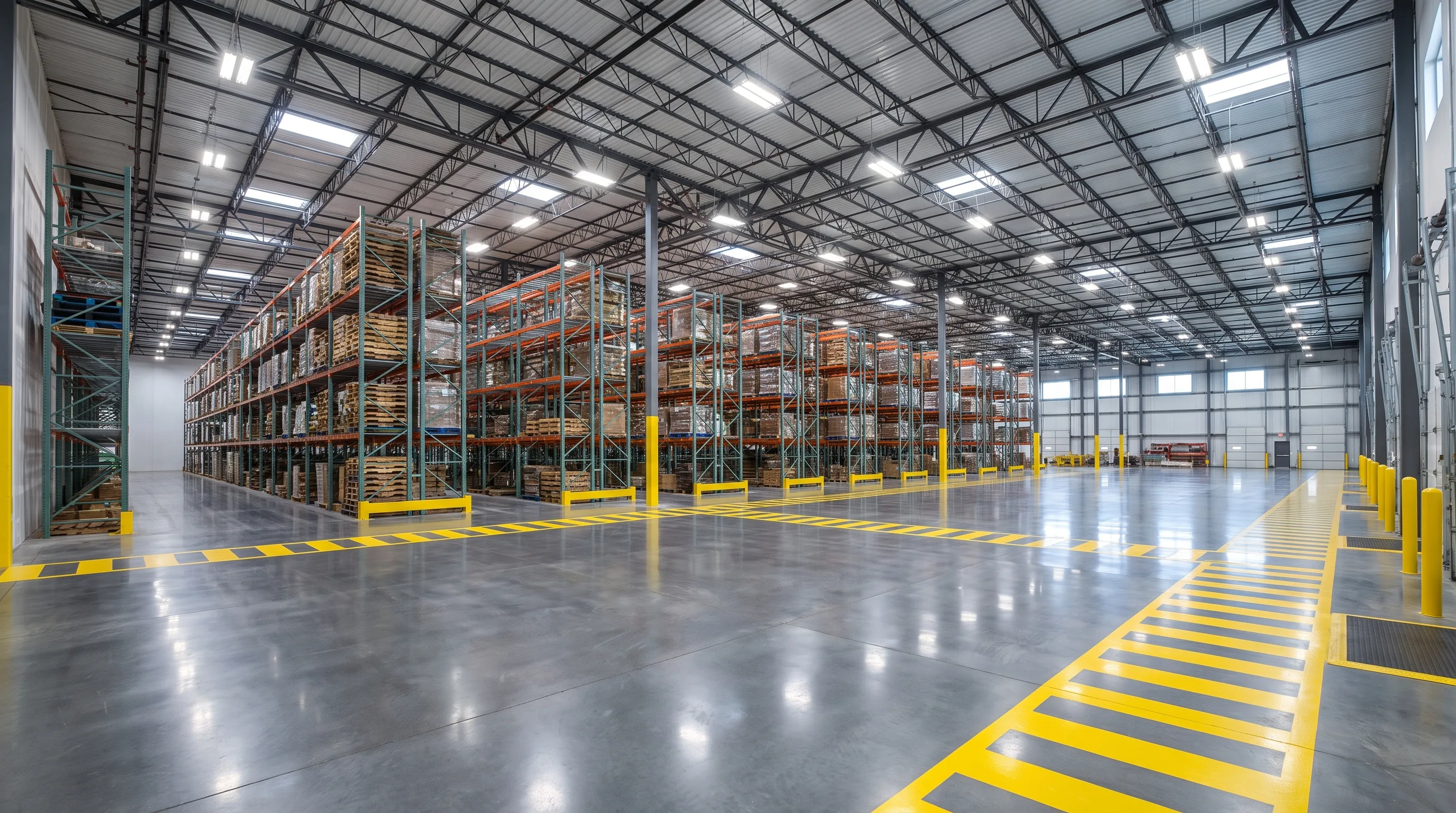
A forklift-rated warehouse floor with mapped traffic lanes — phased installation kept the facility operating throughout.
What Warehouse Epoxy Costs in Denver
Warehouse pricing runs above standard commercial rates because of the added mil thickness and aggregate broadcast required for heavy traffic — but the cost is offset by a system that lasts 15-20 years instead of needing a partial recoat every few years under sustained industrial use.
| System | Best For | Cost / Sq Ft |
|---|---|---|
| Standard BroadcastGeneral warehousing, routine traffic | Storage, light distribution | $6 – $9 |
| Forklift-Rated Heavy BroadcastHigh mil thickness, dense aggregate | Active distribution centers | $9 – $12 |
| Chemical-Resistant Novolac/PolyureaAggressive chemical exposure | Manufacturing, chemical storage | $11 – $14 |
| Crack & Joint RepairAdd-on if needed | Assessed on-site | Varies by scope |
Common Warehouse Coating Mistakes
Warehouse floors fail differently than residential ones — usually in the form of localized wear, delamination along forklift lanes, or coating breakdown around chemical spill zones rather than a single catastrophic failure. Almost all of it traces back to under-specifying the system for the actual traffic and chemical load.
- Using a standard commercial system instead of a forklift-rated one. An 8-10 mil system specified for office or retail traffic wears through in high-traffic warehouse lanes within months, not years.
- Skipping traffic pattern mapping. Uniform coating thickness across the whole floor wastes budget in low-traffic zones and under-protects the lanes that actually need reinforcement.
- Ignoring chemical exposure at spec time. A topcoat chosen for general durability rather than for the specific fluids present in your facility can degrade rapidly in the exact zones where spills happen.
- Not repairing joints and cracks before coating. Control joints and cracks under heavy rack loads need load-transfer detailing, not just a cosmetic fill — skip it and the coating cracks again at the same point.
- Coating the whole floor in one continuous shutdown. Beyond the operational cost, a single massive pour is harder to cure evenly at altitude than smaller, sequenced zones.
Getting the system specification right up front — matched to your actual traffic mapping and chemical inventory — is what separates a warehouse floor that needs a full recoat in 3-5 years from one that runs 15-20 years with only routine maintenance.